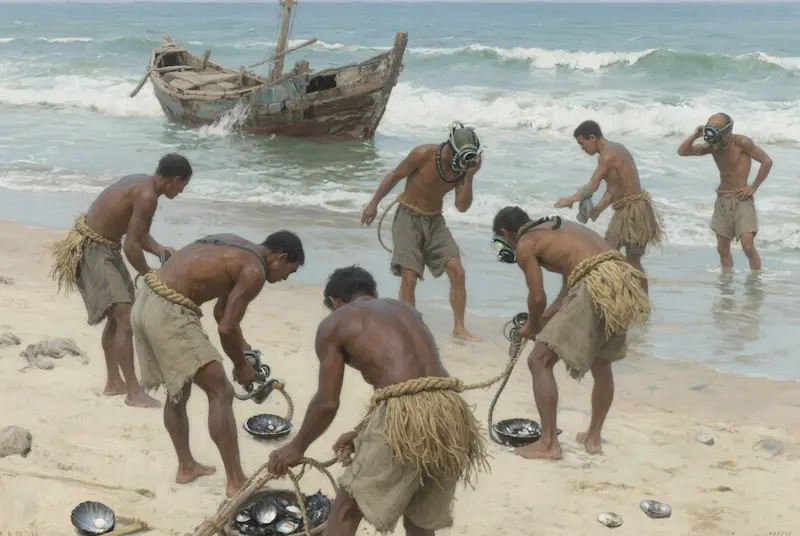
For most of human history, getting a pearl meant risking your life. Throughout the History of Pearl Diving, ancient Chinese divers tied ropes around their waists, filled bamboo baskets, and descended into dark water. They held their breath for three, maybe four minutes while they pried oysters off rocks. If the rope snapped, they drowned. If a shark showed up, they drowned. If they surfaced too fast, their lungs ruptured.
And most of the time? The oysters were empty.
The history of pearl diving is less romantic than you’d think. It’s a story about desperate people doing dangerous work for the slim chance of finding something valuable. But it’s also about how technology eventually made that danger obsolete—and in doing so, probably saved the ocean.
The Era of Risk
The oldest records in the History of Pearl Diving come from China, around 2200 BCE. Divers worked in the Persian Gulf, the Red Sea, and along the coast of what’s now Sri Lanka. The technique was simple: hold your breath, go deep, grab oysters, come back up. Repeat until your body gives out or you find a pearl worth keeping.
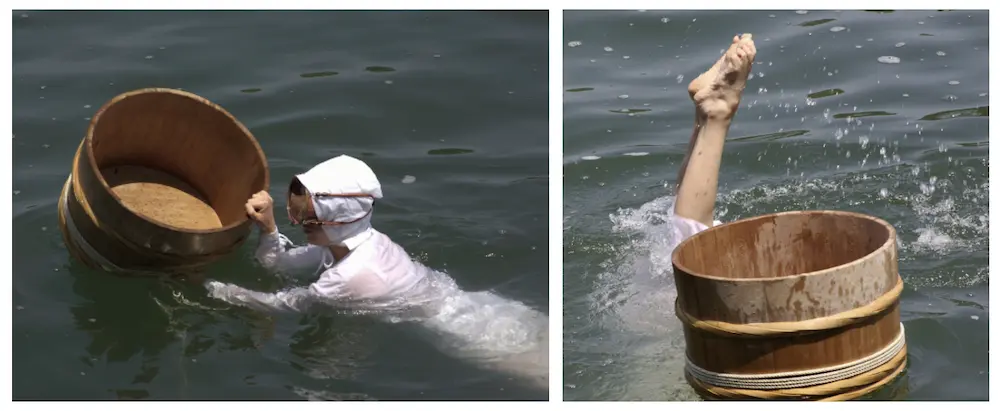
Japanese Ama pearl divers—almost all women—worked into their 70s. They’d dive 30 meters down in cotton robes, no breathing equipment, harvesting abalone and oysters. A good Ama could stay underwater for two minutes. The best ones, longer. But even they had limits. Hypothermia. Shallow water blackout. Nitrogen narcosis if they went too deep.
The Persian Gulf pearling history is particularly grim. During the colonial era, enslaved divers were forced to work the oyster beds off Bahrain and Kuwait. Traders in the gulf port cities got rich. The divers, not so much. If a diver found a large pearl, it might buy their freedom. More often, they just died young.
| Region | Primary Dive Depth | Typical Breath-Hold Time | Main Hazards |
|---|---|---|---|
| Persian Gulf | 10-20 meters | 1.5-2 minutes | Sharks, jellyfish, drowning |
| Japan (Ama divers) | 15-30 meters | 2-2.5 minutes | Hypothermia, blackout |
| South China Sea | 5-15 meters | 1-2 minutes | Sea snakes, currents |
| Australia (Torres Strait) | 20-40 meters | 2-3 minutes | Decompression sickness, sharks |
The dangers of traditional pearl hunting weren’t just physical. In the late 1800s, pearl diving in Australia moved to deeper waters using “hard-hat” diving suits with air pumped from the surface. Divers could stay down longer, but the suits were heavy, the hoses tangled, and decompression sickness—”the bends”—killed more people than sharks ever did.
Mark Dodd’s book The Last Pearling Lugger: A Pearl Diver’s Story describes life on the DMCD, a 52-foot pearling boat that worked the Australian coast in the 1960s, a fascinating chapter in the History of Pearl Diving. Crews lived on these boats for months. The work was brutal. The pay was inconsistent. But there was a freedom to it, too—no bosses on shore, no one telling you when to quit. That world is gone now.
Why the “Old Ways” Had to End
By the early 1900s, wild oyster populations were collapsing, marking a turning point in the History of Pearl Diving. The Persian Gulf oyster beds, once thick enough that you could walk on them at low tide, were nearly fished out. The Red Sea beds were the same. Divers had to go deeper and stay longer just to find the same number of oysters their grandparents pulled up in shallow water.
The problem wasn’t just overfishing. It was math. Wild oysters produce pearls at random—maybe one in 10,000 oysters has a pearl worth selling. To supply the global market, divers were pulling millions of oysters out of the ocean every year. Most got cracked open, checked, and tossed. The ocean couldn’t keep up.
Then in 1893, a Japanese entrepreneur named Mikimoto Kokichi patented a method for cultured pearls. You don’t wait for nature to randomly insert an irritant into an oyster. You do it yourself. You surgically implant a small bead into the oyster’s tissue, the oyster coats it with nacre, and three years later you have a pearl. Controlled. Predictable. Scalable.
This wasn’t a minor tweak. It was the end of wild pearling as an industry.
The natural vs cultured pearls history is a fight between people who insisted cultured pearls were “fake” and people who pointed out they were chemically identical to wild pearls, just made faster. Cultured pearls won. By the 1950s, Japan was producing millions of cultured pearls a year. By the 1970s, wild pearling was basically dead outside of a few tourist operations.
And that’s probably what saved the oysters.
If wild pearl diving had continued at 1900s-level intensity, a critical era in the History of Pearl Diving, the Persian Gulf and Red Sea oyster beds would be extinct. Instead, farmed oysters do the work in controlled environments. The wild populations—what’s left of them—can recover without commercial pressure.
The Modern Pearl Farmer: The New “Diver”
The old pearl diver went into the ocean and hoped to get lucky. The modern pearl farmer creates the conditions for pearls to form, then waits.
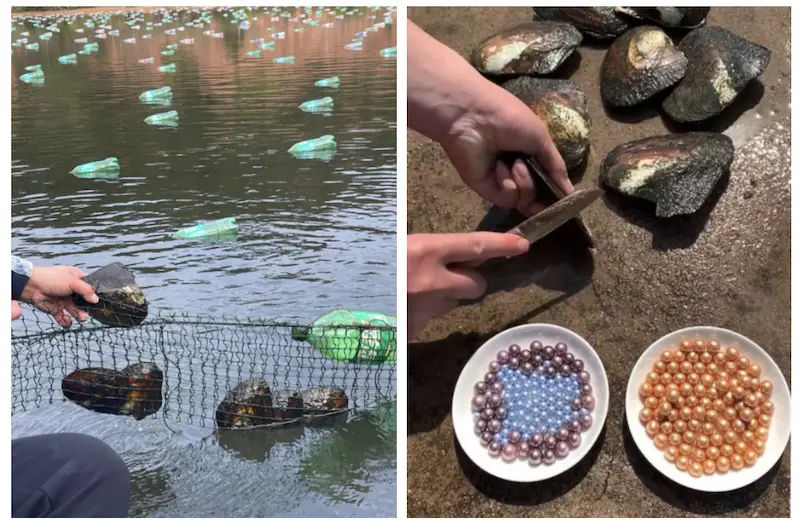
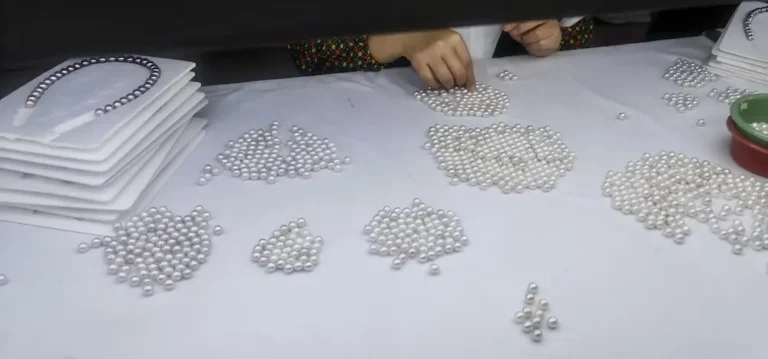
A pearl manufacturer like Xinye Pearls doesn’t send people into dangerous water. They manage oyster farms. The oysters live in cages suspended in lakes or coastal waters. Technicians monitor water quality, temperature, and nutrient levels. Every oyster gets a bead implant. Then you wait 2-5 years.
It’s not dramatic. It’s methodical. But the results are better than anything the old divers could have dreamed of.
Mikimoto Kokichi history is usually told as the story of one man’s genius. That’s half right. Mikimoto spent 20 years testing grafting techniques before he got consistent results. He wasn’t the first person to try culturing pearls—Chinese researchers experimented with it as early as the 13th century. But Mikimoto was the first to scale it commercially. He also understood marketing. He framed cultured pearls not as industrial products but as the “perfection of nature,” which is a bit rich but worked.
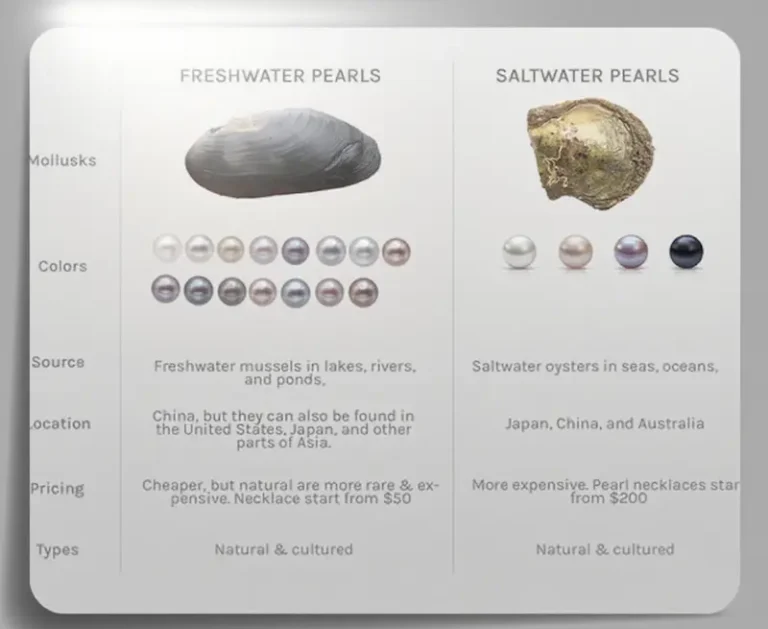
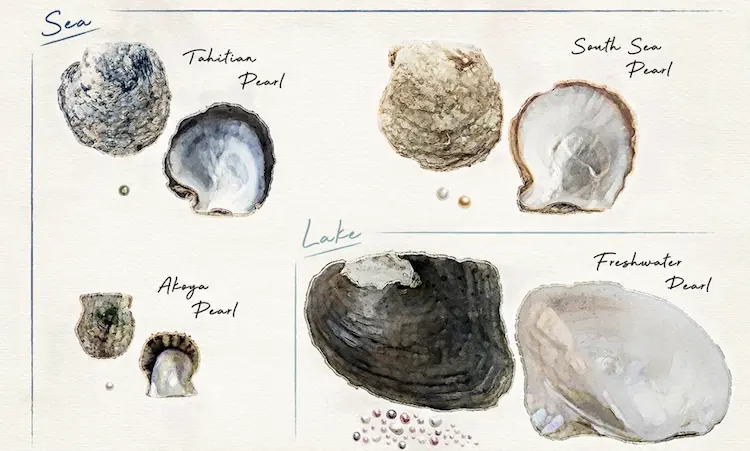
The real revolution came later, with freshwater pearls. Saltwater oysters—like the ones Mikimoto used—are finicky. They need specific temperatures, salinity levels, and clean water. Freshwater mussels are tougher. They tolerate a wider range of conditions, and they produce more pearls per animal. In the 1990s, Chinese pearl farms started flooding the market with freshwater pearls at a fraction of the cost of saltwater pearls.
Then came the Edison pearl: a large, bead-nucleated freshwater pearl that looks like a high-end saltwater pearl but grows in a Chinese lake. It takes 4-6 years to produce one, but the margins are better than saltwater farming. This was the second revolution. Saltwater pearls no longer had a monopoly on size and luster.
Xinye Pearls runs a solar-powered freshwater pearl farm that produces Edison pearls and other high-end cultured varieties. The farm uses renewable energy for water circulation and monitoring systems. The oysters filter the water, which actually improves the lake’s ecosystem instead of degrading it. Compare that to the History of Pearl Diving and the old method: hauling millions of wild oysters out of the ocean, cracking them open, and dumping the shells.
Table: The Evolution of Pearl Sourcing (Risk vs. Sustainability)
| Production Method | Environmental Impact | Success Rate | Time to Market |
|---|---|---|---|
| Wild diving (historical) | High – depletes wild populations | ~0.01% (1 in 10,000) | Immediate (if found) |
| Saltwater cultured | Low – controlled farming | ~50-70% | 2-3 years |
| Freshwater cultured | Very low – regenerative | ~60-80% | 2-6 years |
This is sustainable pearl farming in practice. You’re not extracting from nature. You’re partnering with it.
Ethical Pearl Sourcing: What Retailers Need to Know
If you’re selling pearls, you’re selling a product with a complicated past. Within the History of Pearl Diving, your customers don’t need to hear about every enslaved diver from the 1800s, but they do want to know the pearls weren’t produced through ecological destruction or exploitation.
Ethical pearl sourcing means two things:
- No wild harvesting. If someone is selling “natural” pearls in 2025, they’re either selling very old stock or lying. Wild pearling is illegal in most places and ecologically indefensible in the rest. All legitimate wholesale pearls come from farms.
- Transparent farming practices. Good farms monitor water quality, don’t use harmful chemicals, and pay workers fairly. Bad farms cut corners. Ask your supplier about certifications, worker conditions, and environmental audits.
Here’s the thing your customers actually care about: cultured pearls aren’t “fake.” They’re real pearls, made by real oysters, just with human help. The nacre is identical. The luster is identical. The only difference is that no one had to risk their life or destroy an ecosystem to get them.
Storytelling for Retailers: How to Sell the History
When a customer asks why pearls cost what they cost, the answer isn’t just the History of Pearl Diving or “because they’re rare.” It’s “because it takes 3-5 years for an oyster to produce one, and the process can’t be rushed.”
That’s your story. Not rarity. Not exclusivity. Patience.
Here’s a script you can adapt:
“A hundred years ago, men died diving for pearls. They’d hold their breath for two minutes, go down 30 meters in shark-infested water, and most of the time come up with nothing. We don’t do that anymore. We farm pearls now—but we still can’t make them appear overnight. Each oyster takes years to produce a pearl. You’re not buying a stone. You’re buying time, captured in layers of nacre.”
That sells better than “this is a luxury product.” Because it’s true.
Another angle: the ecological story. Oyster farms clean water. They filter out pollutants. They provide habitat for other marine life. Buying cultured pearls supports an industry that improves aquatic ecosystems instead of wrecking them. If your customer cares about sustainability, that’s your hook.

What Killed Traditional Pearl Diving (And Why That’s Good)
The history of pearl diving ended for three reasons:
- Depletion. By 1900, wild oyster beds couldn’t keep up with demand.
- Technology. Mikimoto’s grafting method made cultured pearls viable.
- Economics. Cultured pearls were cheaper, more consistent, and didn’t require sending people into dangerous water.
The romance of pearl diving—the lone diver braving the depths—makes for good stories. But the reality was exploitation, death, and environmental collapse. The shift to farming wasn’t a loss. It was necessary.
Some people still dive for pearls. In Japan, a few Ama divers work for tourists, demonstrating the old techniques. In the Persian Gulf, you can hire a guide to take you “pearl diving” for a day. It’s heritage tourism, not industry. The actual pearls come from farms.
And that’s fine. The old ways don’t need to come back. They were brutal, inefficient, and unsustainable. What replaced them is better in every measurable way.
The Future: Technology Meets Tradition
Pearl farming is still evolving, representing a significant shift from the History of Pearl Diving. Researchers are testing new grafting techniques that reduce rejection rates. Some farms are experimenting with lab-grown nacre, though that’s years away from being commercially viable. Others are breeding oyster strains that produce larger, more lustrous pearls in less time.
The biggest change is transparency. Customers want to know where their pearls came from, how the oysters were treated, and whether the farm treats its workers fairly. The industry is responding. More farms are getting third-party audits. More suppliers are publishing details about their sourcing.
If you’re a retailer, this is good for you. You can sell on ethics, not just aesthetics. You can tell customers, “This pearl came from a solar-powered farm in China that filters lake water and pays workers above minimum wage.” That’s a better story than “this pearl is rare.”
The history of pearl diving is a history of risk, exploitation, and ecological damage. The history of pearl farming is about making that obsolete. We don’t risk lives anymore. We don’t strip the ocean bare. We wait for oysters to do what they’ve always done—coat an irritant with nacre—and we do it in a way that doesn’t destroy the planet.
That’s the real story. Sell that.
Key Takeaways for Retailers
- Cultured pearls are real pearls. Made by oysters, identical to wild pearls, just more ethical.
- Wild pearling nearly destroyed oyster populations. Farming saved the species.
- Your customers care about sustainability. Tell them about solar-powered farms and water filtration.
- The story isn’t rarity—it’s patience. 3-5 years per pearl. That’s what you’re selling.
- Ethical sourcing matters. Ask suppliers about worker conditions and environmental audits.
Modern cultured pearls are a triumph of sustainability and technology. Don’t just sell jewelry. Sell the legacy.