Pearl supplier selection is the single decision that separates jewelry brands with 40% margins from ones bleeding out at 12%. This guide tells you how to get it right — before you wire a dollar overseas.
The hidden cost of middlemen
China produces over 80% of the world’s freshwater pearls. That’s the easy fact. The harder fact: most buyers don’t buy from China. They buy from a trading company that bought from a distributor that bought from a wholesale market that bought from us — the pearl farm.
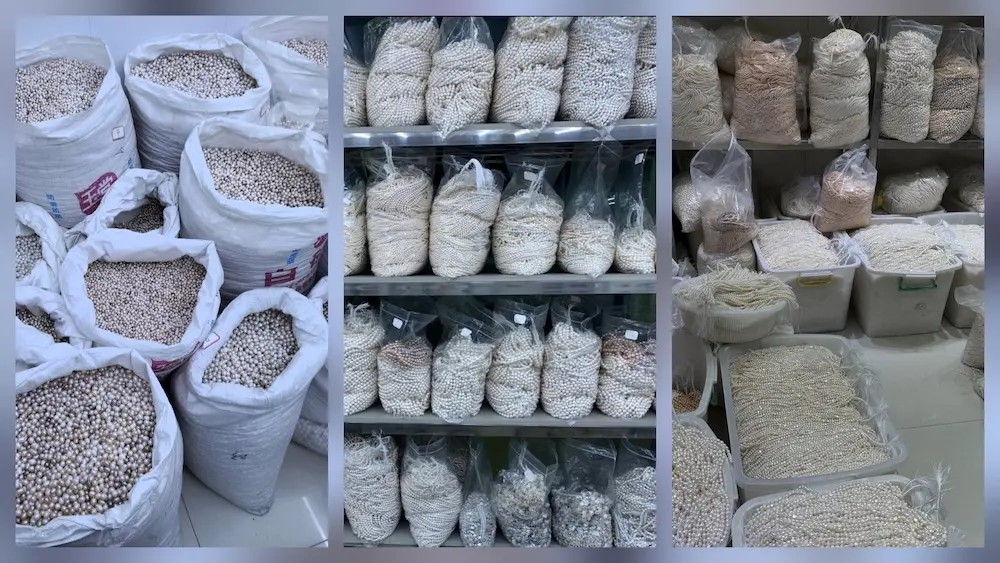
By the time a 7mm-8mm round freshwater pearl reaches your warehouse in Los Angeles or Frankfurt, it has passed through three or four pairs of hands. Each pair takes 15–30% margin. You’re not paying for better pearls. You’re paying for their rent.
That’s not a vague claim. I’ve sat across from buyers who showed me invoices from “manufacturers” — and I recognized the product photos. Same lighting, same background, same flawed matching. They were paying $8/strand for pearls we sell at $3.20/strand direct. The difference went nowhere useful.
Supply chain transparency isn’t a buzzword. It’s the difference between a business that scales and one that limps.
The 3 tiers of pearl suppliers (and what each actually means for your margins)
Most buyers lump all pearl suppliers together. That’s a mistake. There are three distinct tiers, and they operate completely differently.
Tier 1: Farmers and manufacturers — the source
This is where pearls start. Tier 1 operations own the water. They control mussel breeding, nucleation, harvest timing, and post-harvest processing. At Xinye Pearl, our freshwater farming base covers over 1,000,000 square meters in Ma’anshan, Anhui. Our Changzhou factory handles drilling, sorting, matching, and export packaging under one roof.
When you buy Tier 1, you’re buying at production cost plus a factory margin. MOQs are typically higher (ask us — it depends on product), but the price-per-unit drops sharply at volume.
Tier 2: Wholesale distributors
These are the Zhuji market players. They aggregate product from multiple farms, which means variety and shorter lead times for small orders. The tradeoff: they don’t control quality at the source. A batch of “AAA” pearls from a distributor might actually be a mix of two farms’ output sorted together. Consistency across large reorders is the real risk here.
Tier 3: Trading companies and brokers
They have a nice website, fluent English reps, and zero pearls. Trading companies buy from Tier 2, add margin, and act as your cultural intermediary. For tiny orders or first-time buyers nervous about direct sourcing, there’s a use case. For anyone ordering 10kg+ regularly, you’re burning money.
The keyword you want to search is direct pearl manufacturer China — not just “pearl supplier China,” which surfaces mostly Tier 3 results optimized for Google, not for your order.
Why Akoya shortages make freshwater supply chains matter more
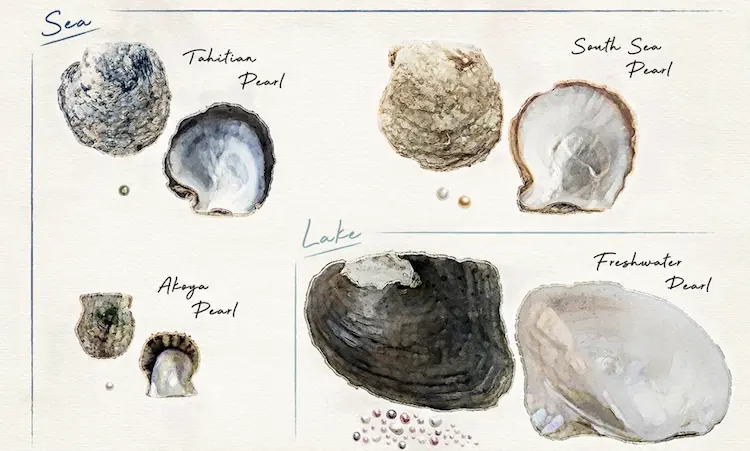
Japan produced 13.2 tons of Akoya pearls in 2023 — the lowest figure since the government began keeping records in 1956, down from a peak of 138 tons in 1967. A birnavirus outbreak, rising sea temperatures, and a 77% drop in the number of active farming businesses over 30 years have pushed supply to a structural floor. Auction prices rose 40% in 2024 alone, with sizes 7mm and above up more than 50%. (AGTA Pearl Update 2023 / Reuters via IOL, Dec 2025)
This isn’t a short-term dip. The CIBJO Pearl Commission Special Report 2024 confirms the structural decline is ongoing.
For jewelry brands sourcing round, high-luster pearls: freshwater alternatives — specifically freshwater AK-style pearls (bead-nucleated, Akoya-like roundness) and Edison pearls — now fill the gap Akoya can’t. Supply is stable. The farming base is in China, where we control the water. There is no virus. There is no aging workforce crisis. Lead times don’t shift 40% between seasons.
That’s not a sales pitch. It’s a supply chain reality your margins depend on.
How to verify a genuine pearl wholesale supplier
Here’s the question I get most: “How do I know you’re actually the manufacturer?”
Fair question. Here’s a checklist I’d run on any pearl supplier — including us.
| Verification check | What to ask | Red flag |
|---|---|---|
| Farm documentation | Request GPS coordinates or aerial video of the farm | Stock photos of “a lake” |
| Factory walk-through | Ask for a live video call from the factory floor | Pre-recorded clips only |
| Equipment proof | Do they own automated sorting machines? | Hand-sorting only at claimed scale |
| Export documentation | Can they provide a Certificate of Origin (CO)? | “We’ll figure that out later” |
| Drilling capability | Can they drill, match, and sort in-house? | Subcontracting core processes |
| Sample lead time | How long to ship a sample? | More than 7 business days |
| Reorder consistency | Ask for batch photos from 3 previous orders | Refuses or can’t produce |
How to verify a pearl wholesale supplier comes down to one principle: make them show, not tell. Any pearl supplier can write “factory direct” in their bio. Fewer can send you a video of 500kg of Edison pearls being sorted.
Factory-direct Edison pearl supply chain: what it actually looks like
Edison pearls are a specific product — large, round, nucleated freshwater pearls grown with a technique developed in China around 2010. They’re not akoya. They’re not South Sea. They need their own supply chain explanation.
The factory-direct Edison pearl supply chain works like this at Xinye:
- Nucleation — Surgical-grade freshwater mussel receives a nuclei implant. Success rate varies; failed nucleations reduce saleable yield, which is why Edison pearls cost more than standard freshwater.
- Growth cycle — 2–5 years in our Ma’anshan pearl farming base. We control water quality, mussel nutrition, and harvest timing.
- Harvest and grading — Pearls are harvested, cleaned, and run through automated grading equipment in Changzhou to sort by size (±0.5mm tolerance or ±1mm tolerance), shape (round, near-round, drop, baroque), and luster (AAAAA/AAAA/AAA/AA/A).
- Processing — Drilling, matching for strands, strand knotting, or loose supply depending on your order.
- Export — We handle customs documentation, CO certificates, and coordinate with your freight forwarder directly.
What disappears from this chain when you go factory-direct: the wholesale market stop, the trading company markup, the repackaging, and the quality dilution that happens when a distributor blends batches.
Bulk pearl ordering process for jewelry brands
Scaling from sampling to bulk is where most jewelry brand buyers get stuck. The process isn’t complicated, but the sequence matters.
Step 1: Define your spec sheet before you contact anyone.
Size range, shape tolerance, luster grade, hole diameter, whether you need matched strands or loose, and your target landed cost per gram or per strand. If you can’t answer these questions, you’re not ready to order bulk. You’re ready to browse.
Step 2: Run a paid sample order.
Never skip samples. A $200 sample order will tell you more about a pearl supplier’s quality and reliability than 40 emails. At our factory, sample lead time is 1–3 business days.
Step 3: Negotiate on volume tiers, not just unit price.
The bulk pearl ordering process for jewelry brands that works best involves committing to a volume tier for the year — even informally — and getting tiered pricing in return. Example: ordering 50kg/year vs 200kg/year changes your per-strand cost meaningfully. Ask for a pricing schedule, not a single quote.
Step 4: Clarify logistics upfront.
EXW (Ex Works) or FOB Ningbo/Shanghai? Who arranges freight? Who handles import duties on your end? These aren’t afterthoughts. A $2,000 freight surprise on your first container erases your margin math.
Step 5: Build in a QC step.
For orders over 20kg, either visit the factory pre-shipment or hire a third-party QC inspector in China (costs is generally around 0.08% of the cargo value.). We welcome both.
Sustainable pearl farming practices in 2026
This section matters more than it did five years ago. Buyers in the EU and North America increasingly want documentation on environmental impact — not because it’s nice to have, but because their end customers are asking.
Sustainable pearl farming practices in 2026 center on three things: water management, mussel mortality rates, and chemical use.
At our Ma’anshan pearl farm base:
- We operate in natural freshwater lakes with seasonal rotation. Mussels are not farmed in chemical-treated pools.
- Mussel mortality (failed nucleations and natural deaths) are composted on-site. No lake dumping.
- We don’t use antibiotics or growth hormones — freshwater pearl mussels don’t require them when water quality is managed properly.
- We can provide basic environmental documentation on request. Third-party certification (like ASC) is not yet standard for Chinese freshwater farms, but farm-level documentation of practices is available.
I’ll be honest: the freshwater pearl industry is behind saltwater (akoya, South Sea) on formal sustainability certification. Anyone claiming full third-party verified sustainability for Chinese freshwater pearls in 2026 is overstating what exists.
Documentation has its limits; nothing beats seeing the real thing. We invite you to visit our pearl farm directly to experience our standards in person.
Pearl grading reference table
Use this when evaluating any wholesale pearl supplier’s product claims.
| Grade | Luster | Surface | Shape tolerance | Typical use |
|---|---|---|---|---|
| AAAAA | Mirror-bright, razor-sharp reflection | <2% inclusions | Round within 1% | Top-tier fine jewelry, bridal, collector pieces |
| AAAA | High luster, near-mirror finish | <5% inclusions | Round within 2% | Fine jewelry, premium retail |
| AAA | Good luster, slight diffusion | <10% inclusions | Near-round within 5% | Fashion jewelry, mid-range retail |
| AA | Moderate luster, visible banding | <20% inclusions | Baroque acceptable | Casual jewelry, craft |
| A | Low luster | <35% inclusions | Freeform/baroque | Kids’ jewelry, décor, filler strands |
Most pearl manufacturer listings don’t tell you what their “AAAAA” actually means. Get the specific criteria in writing before you order.
FAQ: sourcing wholesale pearls in 2026
What is the minimum order quantity (MOQ) for factory-direct prices?
It depends on the product. Send us your spec in one line. We reply with a real number, not a contact form redirect.
How do you ensure quality consistency in a 500kg order?
We batch-sort every large order through automated grading equipment. For 500kg+, we photograph sample pulls at 10%, 50%, and 90% completion and send them to the buyer before shipping. The process works.
Can I visit the farm and factory?
Yes. We’re in Changzhou (factory) and Ma’anshan (farm). Both are accessible from Shanghai. If you’re sourcing at scale, I’d recommend visiting. Most buyers who visit once come back annually.
Do you provide certificates of authenticity?
We provide CO (Certificate of Origin) for all export shipments. We can provide professional third-party certifications upon request to meet your specific requirements for the freshwater pearls.
What’s your lead time for a 50kg custom order?
Standard production: 15–20 business days after deposit. Rush (10 business days): available on select products at a 10–15% premium. Confirm before ordering.
The right pearl supplier isn’t the cheapest one you found on Alibaba or the most expensive one with the best English website. It’s the one who can show you their farm, send you consistent samples, and price you at factory margins — not three layers of markup above them.
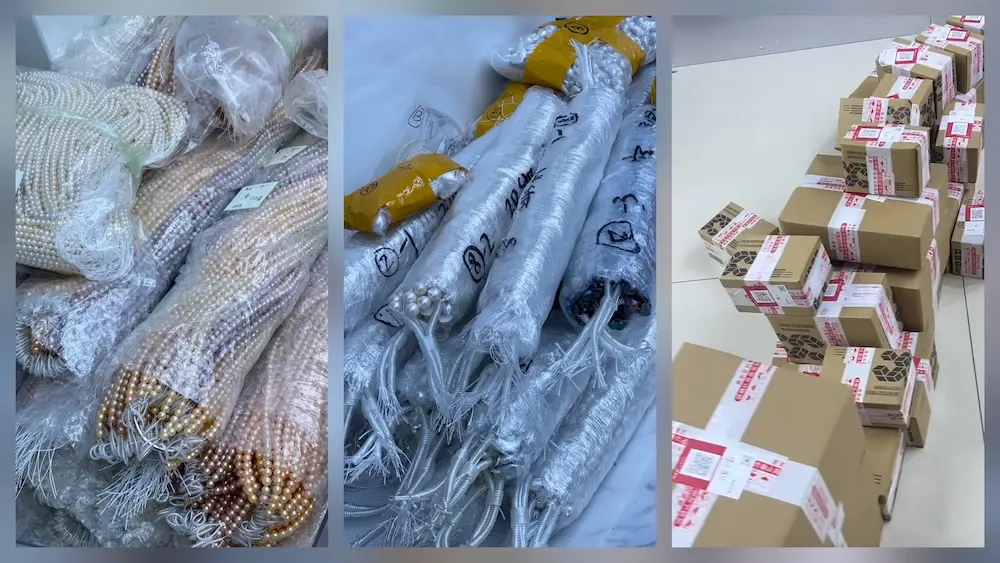
We’re that pearl supplier. The pearl farm is real. The pearl factory is in Changzhou. The freshwater pearls are ours from the water up.