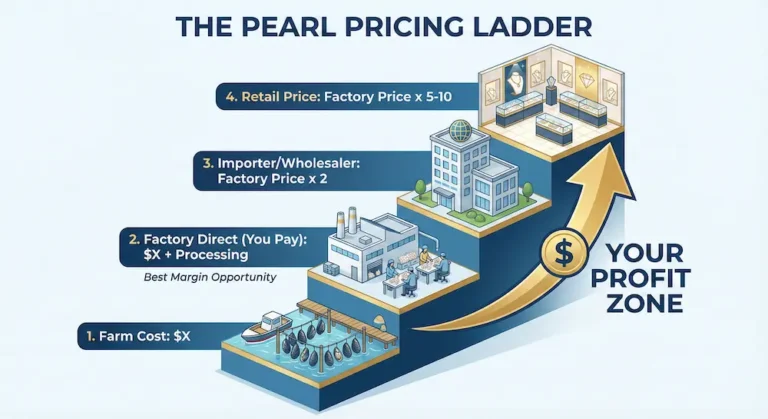
The only Guide to Freshwater Pearls you’ll need in 2026 — written by someone who actually farms them.
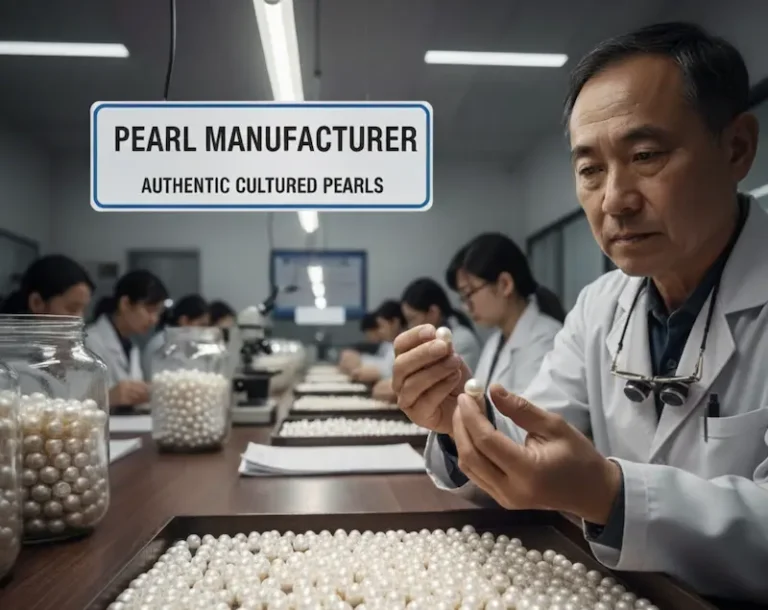
I run Xinye Pearl in China. Our farming base is in Ma’anshan, Anhui. Our processing factory is in Changzhou, Jiangsu. That covers the full supply chain: nucleation, five-year grow-out, harvest, sorting, drilling, stringing, and export. I’ve worked this industry for over a decade. This guide to freshwater pearls gives you what that experience actually looks like — grading logic, cultivation science, market data, and the scams to avoid.
If you’re a jewelry brand, a retailer, or a sourcing manager, read this before you place your next order.
The 2026 freshwater pearl market: what changed
Freshwater pearls had a reputation problem. For two decades, “freshwater” meant cheap, lumpy, off-color rice pearls in discount bins. That era is done.
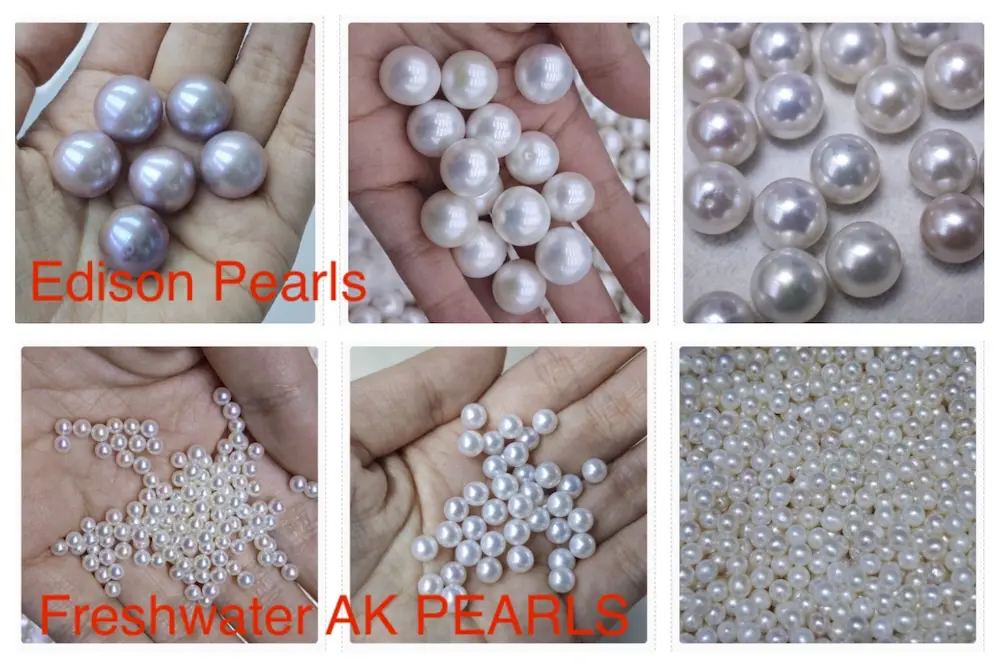
- Edison pearls — a nucleated freshwater variety bred for size — now reach 15mm+ with metallic luster that buyers in 2010 would have attributed only to South Sea production. Baroque freshwater pearls are in luxury editorials. Chinese farms have spent 15 years improving water management, nucleation skill, and post-harvest processing. The result is a freshwater pearl that competes on luster, not just price.
- Freshwater AK pearls are a different story — and a smarter buy for brands that want the Akoya look without the Akoya price. AK pearls are bead-nucleated freshwater pearls, round or near-round, typically 3–9mm, with a white or cream body color and the kind of sharp, mirror-like luster that used to require Japanese Akoya production. The nacre is still 100% freshwater. The look is nearly identical in a finished piece. I’ve watched jewelry buyers hold an AK strand and an Akoya strand side by side under store lighting and call it a draw. That’s where freshwater technology is now.
This guide to freshwater pearls covers it all: where they come from, how they’re graded, how to tell real from fake, how to care for them, and where the 2026 market is moving. Work through each section or jump to what’s relevant to your sourcing decisions.
The source: sustainable cultivation and modern technology at Ma’anshan
The best way to understand freshwater pearls is to start where they start. Here’s what cultivation looks like at our base in Ma’anshan, Anhui.
How freshwater pearls are cultured in China
A technician makes a small incision in the mantle tissue of a freshwater mussel — typically Hyriopsis cumingii, the triangle mussel. A small piece of donor mantle tissue is inserted. For larger pearls like Edison, a bead nucleus goes in alongside the tissue. The mussel returns to the lake or pond.
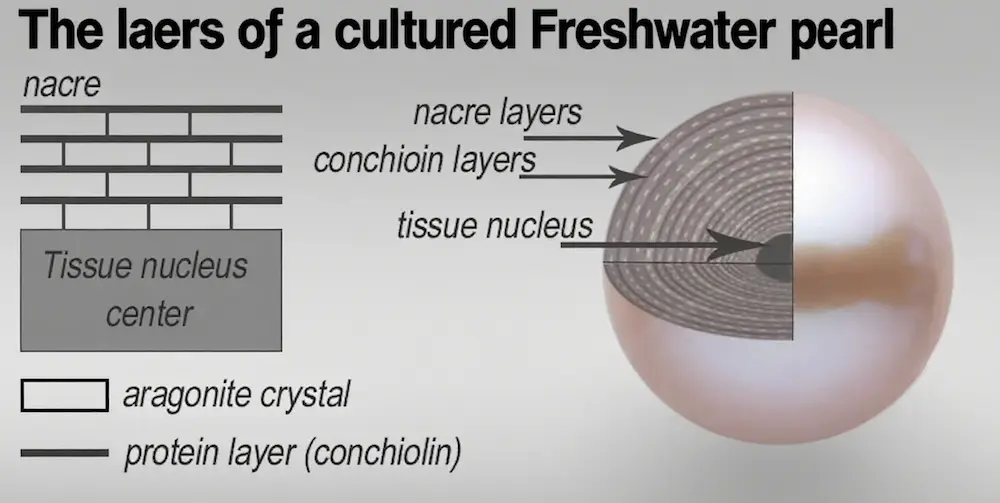
What happens next takes years: The mussel deposits nacre around the irritant, layer by layer, season by season. Nacre deposition rate depends on water temperature and dissolved oxygen. Mussel health is the third variable — and the hardest to control. We track all of it continuously.
Positive Environmental Impact of Solar-Powered Pearl Farms
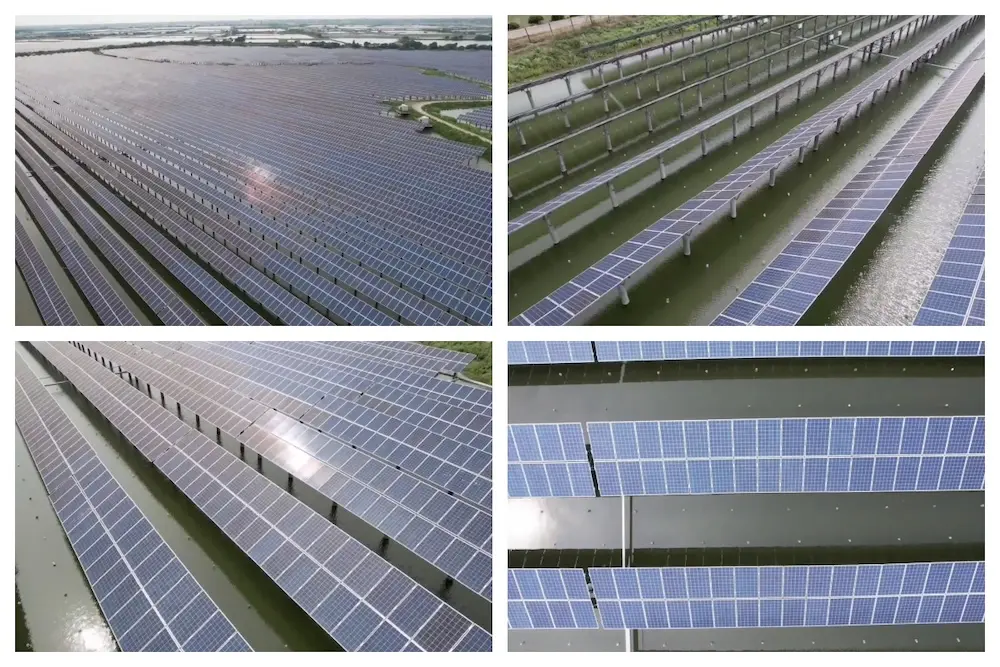
Our Ma’anshan base generates solar power and feeds it directly into China’s State Grid. That clean electricity enters the national network and displaces coal-fired generation elsewhere in the system. It’s not a symbolic gesture. Every kilowatt-hour we push into the grid is one that doesn’t come from a coal plant. For a farming operation running 24-hour water monitoring equipment year-round, the cumulative carbon reduction is real.
Pearl farming is already low-impact compared to land-based livestock or crop agriculture — mussels filter-feed, require no fertilizer, and actively improve water quality by removing suspended particles. Adding solar generation on top of that means our Ma’anshan base runs as close to carbon-neutral as a working farm can get.
What does this do for pearl quality? Mussels under stress — from temperature spikes, oxygen dips, or pollution — produce thinner, irregular nacre. Stable water conditions produce consistent luster. That connection is confirmed by pearl biology research from GIA’s pearl division, and it’s exactly what our sensor data shows over years of operation.
Rush this and you get thin nacre. Thin nacre means dull pearls that chip within years. I’ve seen suppliers harvest at 12 months and sell it as premium stock. It’s not. Any useful guide to freshwater pearls will tell you: nacre thickness is everything, and time is the only way to get it.
Professional grading: the 7 value factors
Freshwater pearl quality standards use a 5-tier system: A, AA, AAA, AAAA, and AAAAA. AAAAA is the top. A is commercial grade — suitable for promotional items, not fine jewelry.
Seven factors determine which grade a pearl earns.
| Factor | What top grade looks like | Common flaw in lower grades |
|---|---|---|
| Luster | Mirror-like, deep reflection | Chalky, waxy, or dull surface |
| Surface | Clean, spot-free | Pits, bumps, wrinkles, cracks |
| Shape | Near-perfect round or symmetrical drop | Flat spots, asymmetry |
| Size | Consistent mm measurement, larger = rarer | Overstated diameter |
| Color | Even body color, clean overtone | Uneven tone or dye saturation |
| Nacre thickness | Thick, durable, no bead visible through drill hole | Thin coating that wears or chips |
| Matching | Strand-level uniformity in luster, size, color | Visible inconsistency across a strand |
Most buyers focus on luster and surface. Those matter. But matching is where strands fall apart — a single dull pearl breaks the visual rhythm of an entire necklace.
Deep Dive: Master our professional pearl grading system
Market strategy: freshwater vs. seawater in 2026
Brands ask me this every quarter: “Freshwater or Akoya?”
Here’s the direct answer.
Freshwater pearls are 100% nacre, and nucleated freshwater pearls also have a thicker nacre layer. Akoya pearls have a thin nacre coating over a bead nucleus — typically 0.3–0.8mm of nacre over shell. Non-nucleated freshwater pearls are solid nacre through the center. That nacre doesn’t chip. It doesn’t wear thin after five years of daily use.
On price, a matched strand of AAAAA freshwater pearls in 7–8mm retails for a fraction of comparable Akoya. For a brand building accessible luxury — or a reseller who needs margin room — freshwater wins on economics without compromising on longevity.
Edison pearls change the calculus further. At 10–15mm with metallic overtones, they photograph like South Sea pearls. The price difference is significant. For brands who want that premium look without the South Sea price tag, Edison freshwater is the answer in 2026.
Full Comparison: Is Freshwater or Seawater Pearl right for your brand?
Authenticity: 3 fast ways to spot real freshwater pearls
We’ve shipped wholesale pearls to buyers in over 40 countries. Every first-time buyer asks the same thing: “How do I know these are real?”
Three checks that take under two minutes.
1. The friction test. Rub two pearls lightly against each other. Real nacre creates a subtle resistance — a dry, fine-grain friction you can feel in your fingertips. Fakes slide. Glass beads feel glassy. Plastic feels frictionless. No tools, no equipment. Thirty seconds and you have an answer.
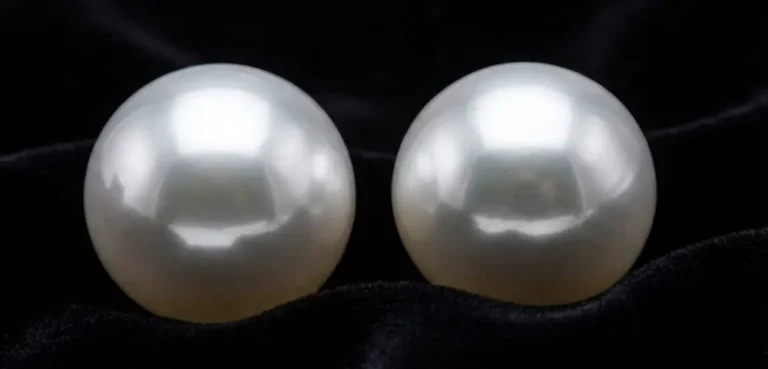
2. The luster-under-light check. Real nacre reflects light with depth. You see your own reflection inside the surface, not just on it. Fakes reflect flat, like a painted marble.
3. Surface texture at 10x magnification. Real pearls show a layered, textured surface under magnification. Coated glass shows uniform smoothness — sometimes with air bubbles near the drill hole where the coating was applied.
Dyed pearls need a different check. Look at the drill hole. If the color is concentrated there, or pooled in the surface grooves — it’s dye. Natural color is distributed evenly through the nacre.
I’ve seen wholesalers get burned by dyed freshwater pearls passed off as natural lavender or natural pink. Our sorting process runs under calibrated daylight-balanced lighting. Color is verified before packaging and again before shipment.
Read the Expert Guide: 9 ways to identify real freshwater pearls
Longevity: how to keep pearls looking good for decades
Pearls are organic. They came from a living animal, and they respond to their environment after harvest. Most buyers don’t treat them that way.
Storage matters more than cleaning. Never seal pearls in an airtight container or zip-lock bag. Nacre needs slight ambient humidity. Sealed plastic dries the surface over years, causing micro-cracking that dulls luster permanently. Store in a soft cloth pouch, separate from metal jewelry that scratches.
Last on, first off. Perfume, hairspray, and cosmetics contain solvents and acids that degrade nacre over time. Pearls go on after your routine is finished.
Wipe after every wear. A dry soft cloth removes skin oils before they build up. It takes ten seconds. Skip this for five years and the luster goes flat.
Maintenance Tips: How to Clean Pearls
2026 global trends: where freshwater pearls are going
No guide to freshwater pearls in 2026 is complete without looking at where the market is moving.
Baroque pearls moving into luxury positioning
Irregular shapes used to be sorted out. Now, designers are requesting baroque and keshi pearls specifically. The asymmetry reads as natural and artisan — which is exactly what premium buyers want in a market saturated with perfect machine-cut stones. Purchase orders at Xinye Pearl have shifted toward baroque shapes from clients in Europe and North America.
Men’s jewelry demand is growing
Men’s pearl jewelry is a real growth category. Not just single-pearl stud earrings — full necklaces, bracelets, and layered looks are moving through retail. Our darker freshwater pearl tones — grey, deep lavender, peacock — are being bought by menswear brands who wouldn’t have considered pearls four years ago.
Supply chain transparency is now a buying criterion
Buyers in 2026 want documentation. Farm location, carbon profile, labor traceability. We can answer all three for every lot from Ma’anshan. Farms that can’t answer are losing accounts. According to the Responsible Jewellery Council, supply chain traceability is a core certification requirement — and adoption among fine jewelry retailers is accelerating. This is not a trend that reverses.
FAQ
What is the largest size of a cultured freshwater pearl?
A: Edison pearls regularly reach 10–15mm. Exceptional pieces go past 16-18mm. Solid nacre, strong luster — a direct visual alternative to South Sea at a price point most brands can work with.
Why choose freshwater pearls over seawater pearls in 2026?
Three types, three answers. Non-nucleated freshwater is solid nacre — no bead, no chipping. Edison is nucleated but with nacre far thicker than Akoya, up to 15mm+. Freshwater AK is nucleated for Akoya-level roundness and luster. All three beat seawater on price at equivalent grades.
Why are freshwater pearls so cheap?
Freshwater pearls are generally cheaper than saltwater pearls due to factors like their abundance, lower production costs. Freshwater mussels can produce multiple pearls at once, which increases supply and decreases individual pearl value.
This guide to freshwater pearls covers the full picture — cultivation at our Ma’anshan base, grading standards, authentication, care, and 2026 market direction. If you’re ready to source, work with a pearl manufacturer who owns the farming base and runs the Changzhou factory. That’s what we do at Xinye Pearl. Start with the right pearl supplier and every downstream decision gets easier — that’s the real guide to freshwater pearls in practice.