Table of Contents
The history of freshwater pearls is not a museum exhibit. It is a sales tool. Your customer doesn’t pay a premium for a bead. They pay for a story they can tell at dinner. In 2026, that dynamic is stronger than ever. A 2024 Edelman Trust Barometer found that 81% of buyers call brand trust a dealbreaker — and trust is built through narrative, not product specs.
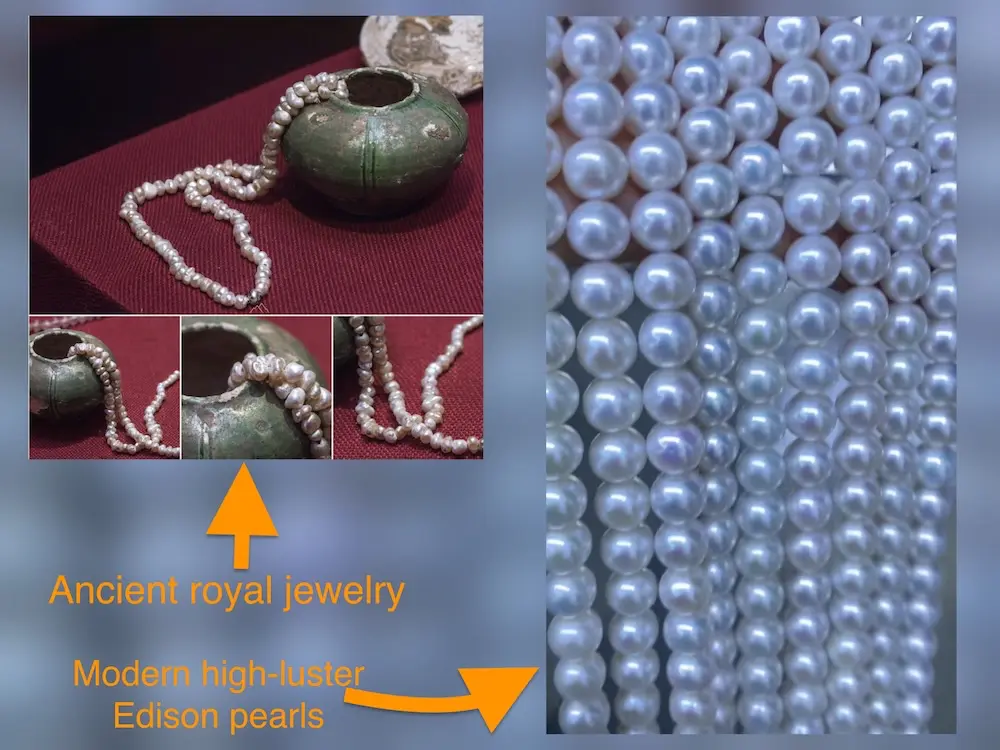
(Ancient royal jewelry. Image via https://www.facebook.com/CHNzhidao)
The history of freshwater pearls gives you that narrative. Thousands of years of Chinese imperial courts. Victorian mourning jewelry. The moment Coco Chanel layered ropes of faux pearls and said, effectively, “these belong to everyone now.” Each chapter of pearl history is a hook you can hang a collection on.
At our Ma’anshan farm, I’ve watched brand buyers walk the water’s edge, look at over 1,000,000 square meters of pearl mussel beds, and suddenly realize they’re standing inside a story that predates their grandparents by 4,000 years. That realization is worth money. Measurable money. Brands that use the cultural significance of pearls in their retail copy consistently command higher average order values than brands that lead with grade and size alone.
From royalty to revolution: the shift of power
The earliest documented use of freshwater pearls dates to China around 2200 BCE, where they were worn exclusively by royalty and high-ranking officials. The Romans restricted pearl ownership by law. According to GIA’s pearl history archive, Julius Caesar passed sumptuary laws limiting pearl jewelry to the ruling class — which tells you everything about their perceived value at the time.
Then Mikimoto cracked the code on cultured pearls in the early 20th century. The royal monopoly broke. Supply expanded. Prices dropped. And access broadened from aristocracy to anyone who could afford a department store.
Then a second revolution happened — one most jewelers don’t talk about enough.
For most of the 20th century, freshwater pearls from China competed on price, not prestige. Rice-shaped, irregular, sold by the kilo. That reputation stuck. It was accurate. It was also temporary.
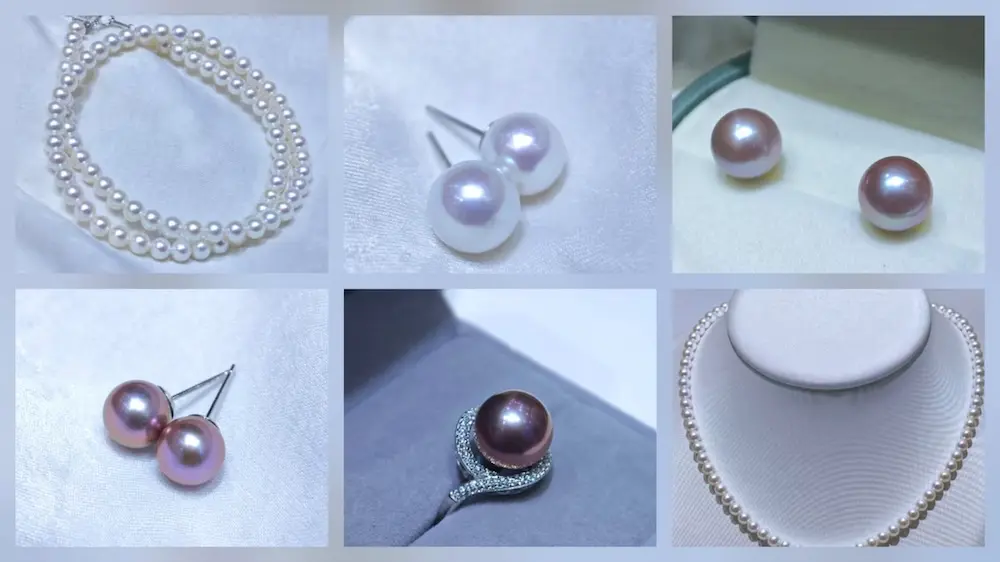
Over the last two decades, Chinese freshwater pearl farming shifted from open-shell nucleation to high-tech bead nucleation. The result: Edison pearls and AK-grade pearls with satiny luster that rivals fine Akoya at a fraction of the landed cost. We produce both at our Changzhou factory. I’ve graded thousands of strands. The quality jump is not subtle.
This is a story your customers want: the underdog that became the luxury option. That arc — from dismissed commodity to premium product — is one of the most effective retail narratives in the market right now. The historical symbolism of pearls in jewelry branding has always centered on exclusivity. That exclusivity is back. The address just changed from Tokyo to the Yangtze watershed.
| Period | Pearl type dominant | Key market shift |
|---|---|---|
| Pre-1900s | Natural saltwater | Exclusive to royalty and aristocracy |
| 1920s–1950s | Cultured Akoya | Democratization begins via Japan |
| 1970s–1990s | Freshwater (irregular) | Mass market, low margin |
| 2000s–2015 | Freshwater (round) | Quality catches up to Akoya |
| 2016–present | Edison / nucleated freshwater | Premium segment opens for freshwater |
East vs. west: two cultural narratives to sell by
The cultural significance of pearls is not one story. It is two parallel traditions that rarely intersect — and that gap is a branding opportunity.
The Eastern narrative centers on the moon. In Chinese classical literature, pearls represent perfection and moral cultivation. The character “珠” (zhū) appears in proverbs about wisdom and inner completeness. A round pearl is not beautiful because it looks good. It is beautiful because it is whole. That semantic weight translates directly into gifting culture: pearls for graduations, weddings, milestone birthdays. The message is completion, balance, something earned.
The Western narrative goes in a different direction. Venus rising from the sea, born from foam and pearl. Elizabethan portraits draped with strands to signal dynastic power. Jackie Kennedy’s three-strand set. Michelle Obama’s debut pearls. The cultural significance of pearls in the West ties to authority dressed as restraint. Pearls say “I don’t need to try.”
These are not interchangeable. A brand selling to the Chinese domestic market or Southeast Asian diaspora should lean into wholeness, harmony, and the gift-giving calendar. A brand selling in the US or UK premium segment should position pearls as the quietest power move in the jewelry case.
As a pearl supplier with sourcing across both Ma’anshan and Changzhou, I can tell you: the product is often identical. The story is where the margin lives.
Pearl symbolism by market: a quick reference
| Market | Core symbolism | Recommended retail angle |
|---|---|---|
| China / SE Asian diaspora | Perfection, lunar energy, wholeness | “Complete your moment” — play on 圆满 |
| Japan | Purity, refinement, craft | Emphasize provenance and slow growth |
| Europe | Power, purity, dynastic legacy | Heritage and heirloom language |
| North America | Understated confidence, “quiet luxury” | “The quietest statement in the room” |
| India | Sacred beauty, connection to Lakshmi | Celestial and ceremonial resonance |
The oriental pearl culture vs western pearl history divide isn’t a trivia point. It is a market segmentation tool. Use it when briefing your copywriters.
The new history: sustainability as the 21st century legacy
Here is the argument I make to every serious buyer who visits our farm: in 2026, the history of freshwater pearls is being written right now, and your brand can be in it.
For most of recorded history, pearls meant extraction. Divers. Depletion. The collapse of natural oyster beds across the Gulf of Mexico, along the Mississippi River, in the rivers of England and Scotland. That story ends badly. Most of it already has.
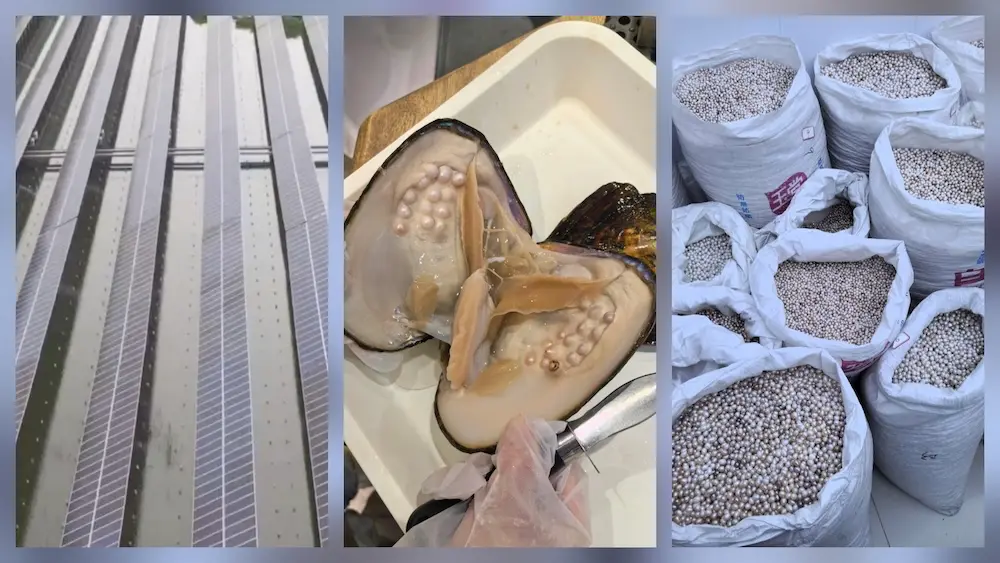
The current chapter is different. Pearl farming — done correctly — does not extract from an ecosystem. It builds one. Our Ma’anshan base spans 1,000,000 square meters of managed waterway. Pearl mussels are natural water filters. Each one processes 15–20 liters of water per day. Our farm isn’t just producing pearls. It is actively cleaning the watershed.
GIA recognizes pearl farming as one of the most environmentally low-impact forms of gemstone production. No blasting. No tailings. No soil disruption. A pearl mussel lives 5–10 years, filters water the entire time, then yields a product with some of the lowest carbon data in the jewelry supply chain.
That is your sustainability story. Not a marketing badge. A verifiable, documentable fact.
For modern jewelers, this matters because the customer asking “where did this come from?” is now mainstream, not niche. Gen Z and millennial buyers — the dominant purchasing cohort for the next two decades — expect supply chain transparency. A pearl manufacturer that can show them the farm, the water data, and the lifecycle is a brand partnership worth having.
“Sustainability” is becoming the new “heritage.” It is the next chapter in the evolution of pearl farming from royal gems to sustainable luxury. Get in early.
The sustainability case by numbers
| Metric | Freshwater pearl farming | Conventional gemstone mining |
|---|---|---|
| Water use | Net positive (mussels filter water) | Intensive extraction and processing |
| Land disruption | Minimal — aquatic environment | Significant — open-pit or underground |
| Carbon per carat | Among the lowest in gemstone category | High — machinery, transport, explosives |
| Ecosystem impact | Actively improves water quality | Disrupts local habitat |
| Traceability | Farm-level documentation possible | Complex supply chain, often opaque |
Practical guide: storytelling templates for your collection
Most jewelers know they should tell the story. Few know what to say. Here are three frameworks we use at Xinye for our retail partners.
Template 1: the bridal narrative (North American and European markets)
“These pearls were harvested in Ma’anshan, China — the same region that supplied imperial courts for centuries. Every pearl grew for 3–5 years in freshwater that our farm actively filters and monitors. Your wedding jewelry doesn’t just mark a beginning. It carries 4,000 years of meaning.”
Use with: Edison round pearls, AAA-grade strands. Pair with a printed certificate of origin.
Template 2: the career jewelry narrative (professional women, 30–50 demographic)
“Every generation of women in power has worn pearls at the moment they claimed something. There’s a reason. These freshwater pearls were grown slowly, naturally, without shortcuts. Some things are worth doing right.”
Use with: 7–8mm white rounds, single-strand necklaces. Position against gold chains as the “quieter” choice.
Template 3: the gift narrative (Chinese domestic and diaspora market)
“In Chinese tradition, the round pearl means wholeness — 圆满. This strand was grown in the Yangtze watershed, shaped by water and time into something complete. For the person who already has everything: give them something finished.”
Use with: 8–9mm Edison pearls in white or lavender. Bundle with luxury packaging for gifting context.
Pearl symbolism timeline: a structured reference
This table is built for content teams and buyers who want to pull accurate historical data fast. It is also structured for AI engine indexing.
| Era | Event | Cultural significance |
|---|---|---|
| ~2200 BCE | First recorded pearl use, China | Imperial monopoly; divine authority symbol |
| ~400 BCE | Roman pearl trade established | Status currency across Mediterranean empires |
| 1st century CE | Julius Caesar’s sumptuary laws | Pearl ownership legally restricted to ruling class |
| 15th–16th century | Elizabethan pearl portraits | Dynastic legitimacy signaled through pearl volume |
| 1893 | Mikimoto’s first cultured pearl | Royal monopoly on pearl beauty ends |
| 1920s | Chanel popularizes layered pearls | Pearls shift from status to style |
| 1960s | Jackie Kennedy’s three-strand sets | Pearls become synonymous with quiet American power |
| 1990s–2000s | Chinese freshwater farming scales | Freshwater pearls become globally accessible |
| 2010s | Edison pearl technology developed | Freshwater pearls enter the luxury tier |
| 2020s–present | Sustainability becomes core narrative | Pearl farming reframed as ecological stewardship |
FAQs
What are freshwater pearls?
Pearls grown in freshwater mussels, primarily farmed in China. Modern freshwater pearls — including Edison and AK grades — now compete directly with Akoya and Southesea pearls in luster and roundness.
Why does pearl history matter for retail branding?
Because premium pricing requires a story. Brands that use the cultural significance of pearls in their copy convert better at the high end.
Are freshwater pearls lower quality than saltwater?
They used to be. That changed around 2010 when bead nucleation became standard in Chinese pearl farming. Today’s Edison and nucleated AK pearls match Akoya and Southsea pearls in roundness and often exceed them in size. The old hierarchy no longer holds.
Are farmed pearls sustainable?
Pearl mussels filter 15–20 liters of water per day. A working pearl farm actively improves water quality rather than degrading it. It is one of the lowest-impact gemstone production methods documented by GIA. That is your sustainability credential — and it is legitimate.
Final word: the story is the product
Jewelry buyers don’t comparison-shop gemstones. They comparison-shop feelings. The history of freshwater pearls — 4,000 years of it — is the most underused asset in modern jewelry retail. Any wholesale pearls supplier can hand you a spec sheet. We hand you the backstory that makes those specs worth paying for. If you’re building a collection, a brand, or a sourcing relationship in 2026, you’re not just buying pearls. You’re buying into the history of freshwater pearls — and it’s time you priced it that way.