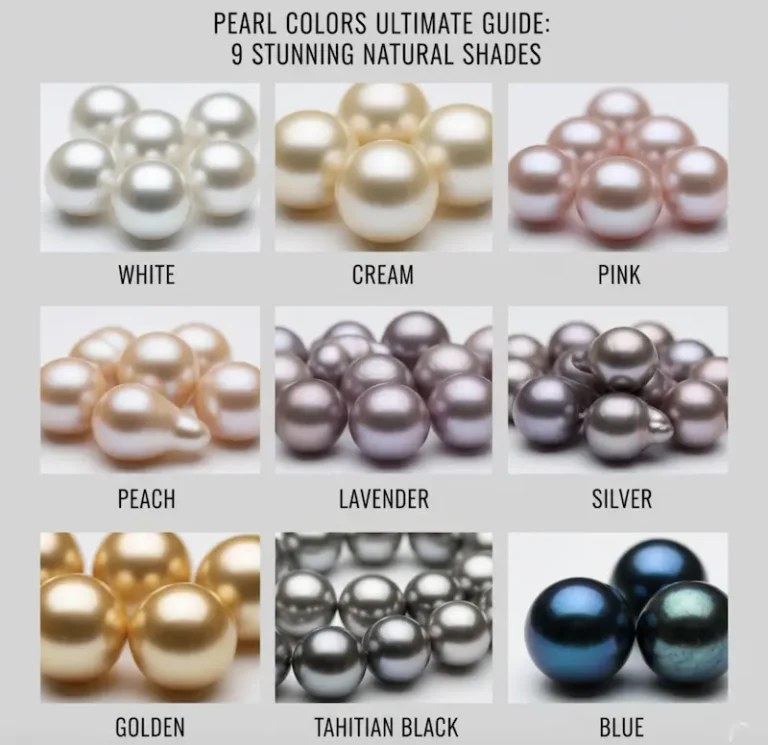
If you’ve ever searched “freshwater vs cultured pearls” and walked away more confused than when you started, this guide is for you. Most articles online get this wrong — badly wrong — because they treat “freshwater” and “cultured” as opposing categories. They’re not. Understanding this distinction will change how you buy, grade, and source pearls entirely.
The category error costing buyers money
Here’s the truth the industry rarely states plainly: every freshwater pearl sold commercially today is a cultured pearl. “Freshwater” tells you the water environment. “Cultured” tells you the growth method. You cannot compare freshwater vs cultured pearls the same way you’d compare apples to oranges — it’s more like comparing a Fuji apple to fruit. One is a subset of the other.
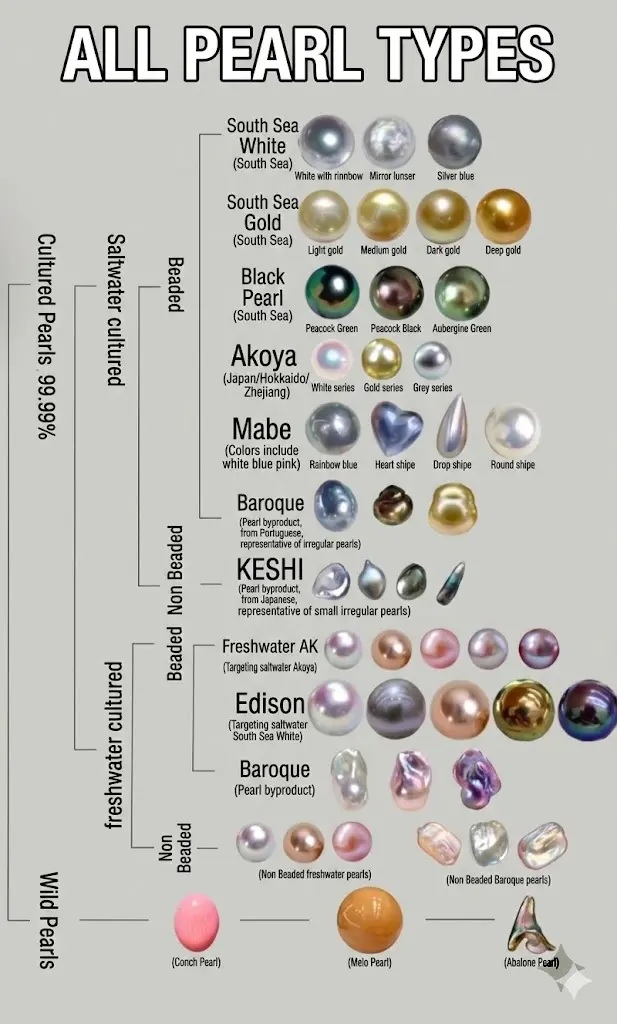
The actual debate when buyers ask about freshwater vs cultured pearls is this: freshwater cultured vs saltwater cultured. That’s the real comparison. That’s where the meaningful differences in price, nacre, durability, and supply chain live.
We run a pearl manufacturer operation with a 1,000,000 m² farming base in Ma’anshan and a processing factory in Changzhou. Every pearl we ship — whether it’s a classic strand or an Edison — is a cultured pearl. All of them. There are no wild pearls in the commercial market. Per GIA’s pearl classification standards, natural pearls make up less than 1% of all pearls sold globally. So when a vendor tells you their product is “not cultured” but “natural,” walk away.
When buyers frame the search as freshwater vs cultured pearls, they’re usually asking one of two things: “Is a freshwater pearl a real pearl?” (yes) or “How do freshwater pearls compare to the Akoya or South Sea pearls I’ve seen?” That second question is the useful one. Let’s answer it properly.
Freshwater cultured vs saltwater cultured: what actually matters
Now that the freshwater vs cultured pearls terminology is settled, here’s the comparison worth having. Freshwater cultured vs saltwater cultured breaks down like this:
| Dimension | Freshwater — Traditional | Freshwater — AK | Freshwater — Edison | Saltwater cultured |
|---|---|---|---|---|
| Nacre thickness | 100% solid nacre (no nucleus) | 0.5mm–2mm over bead nucleus | 3mm–10mm+ over bead nucleus | 0.5mm–2mm over shell bead nucleus |
| Durability | Highest — solid nacre throughout | Very high | Very high — thick nacre rivals South Sea | Moderate — nacre can separate from nucleus |
| Luster ceiling | Medium–high | Mirror luster; competes with Akoya | Mirror luster; competes with South Sea | Strong orient; Akoya is the benchmark |
| Supply consistency | Stable, scalable | Stable, scalable | Stable, scalable | Season- and weather-dependent |
| Shape control | Mostly off-round or baroque | 95%+ round in AAAA–AAAAA lots | High round rate | High for Akoya; variable for South Sea |
The nacre difference is the one that matters most for wholesale buyers. A traditional freshwater pearl at 8mm is 8mm of solid nacre, wall-to-wall. A saltwater Akoya at 8mm has roughly 0.5–1mm of nacre around a 6.5–7mm shell bead nucleus. When that Akoya nacre chips — and with heavy wear, it does — the strand is finished. The freshwater strand survives.
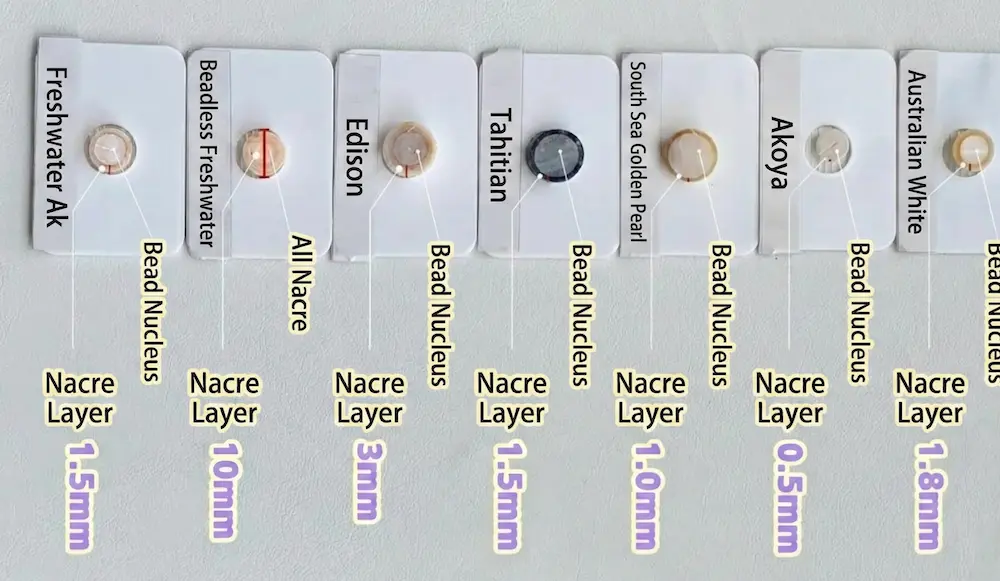
This nacre reality is why the freshwater vs cultured pearls debate lands so differently for B2B buyers than for retail consumers. Retail customers think in terms of prestige labels. Wholesale buyers should think in terms of what survives returns and replacements after two years.
The evolution of freshwater culturing: Freshwater AK and Edison pearls
For 20 years, “freshwater” meant irregular shapes and chalky luster. Discount bin merchandise. That changed around 2015–2018, when Chinese farmers with Hyriopsis cumingii mussels mastered nucleated freshwater cultivation.
The result: Freshwater AK pearls and Edison pearls — and a complete reset of the freshwater vs cultured pearls quality conversation.
Freshwater AK pearls go through a bead-nucleation process similar to Akoya production. A small round nucleus is inserted. The mussel deposits nacre around it for 2–4 years. The finished pearl has near-perfect round shape, mirror-surface luster that competes directly with Akoya, and 100% solid nacre because the nucleus is fully coated during growth.
Edison pearls go further. Large-nucleated cultivation in premium mussels produces pearls from 11mm to 16mm — sizes that historically only South Sea production could match. A 12mm Edison strand in AAAA grade costs a fraction of what a comparable South Sea strand commands from a Pacific farm.
| Pearl type | Typical size range | Nacre type | Luster tier | Best for |
|---|---|---|---|---|
| Traditional freshwater | 2mm–10mm | 100% solid nacre | Low – Medium–high | Volume orders, fashion jewelry |
| Freshwater AK | 3mm–9mm | 0.5mm–2mm over bead nucleus | High–mirror | Jewelry brands targeting Akoya customers |
| Edison Pearls | 8mm–16mm | 3mm–10mm over bead nucleus | High–mirror | Luxury pieces at accessible price points |
| Akoya saltwater | 6mm–9mm | 0.5–1mm nacre | Mirror–orient | Classic pearl jewelry, bridal |
| South Sea saltwater | 9mm–18mm | 2–4mm nacre | Silky–orient | Ultra-premium, statement pieces |
For most wholesale pearls buyers today, the right answer is freshwater AK or Edison. Not because saltwater is bad — Akoya luster is still the standard — but because the value-to-quality ratio has fundamentally shifted. You’re no longer making a compromise when you choose freshwater.
Quality indicators: nacre, luster, and surface
Whether the freshwater vs cultured pearls discussion is about AK rounds or baroque strands, the grading criteria are the same. Here’s what we apply at our Changzhou factory:
Luster is the most important factor. It’s the reflection quality off the pearl surface. The best freshwater AK pearls show mirror luster — you can see a clear, sharp reflection of overhead light. Lesser grades show a diffuse glow without sharp reflection. Don’t buy any pearl — freshwater or saltwater — where you can’t see a clean light source reflected on the surface.
Surface cleanliness matters for price, less so for durability. Our grading scale:
| Grade | Surface blemish allowance | Typical use |
|---|---|---|
| AAAAA | <2% surface affected | Top-tier bridal, luxury retail |
| AAAA | <5% surface affected | High-end retail, fine jewelry |
| AAA | <10% surface affected | Premium fashion jewelry |
| AA | <20% surface affected | Mid-market retail |
| A | <30% surface affected | Fashion, budget lines |
Shape in nucleated freshwater (AK and Edison) now reaches 95%+ round in AAAA and AAAAA lots. Traditional non-nucleated freshwater is still predominantly off-round or baroque.
Size tolerance matters more than most buyers realize. We work to ±0.5mm for matched strands. A “7mm strand” from a serious pearl supplier should contain no pearl below 6.5mm or above 7.5mm — approximately 70 pearls per 16-inch strand at that size. I’ve seen competitor lots swing 1.5mm within a single strand. That’s not a matched strand. That’s unsorted overstock.
Per Gemological Institute of America pearl grading research, luster is the single highest-weighted factor in consumer perception of pearl value. Build your buying criteria around luster first. Surface second.
Nacre thickness: the freshwater vs cultured pearls metric most buyers ignore
The most underused spec in pearl buying is nacre thickness. The freshwater vs cultured pearls comparison looks completely different once you put real numbers to it:
| Pearl type | Nacre thickness |
|---|---|
| Traditional freshwater (non-nucleated) | 100% solid nacre |
| Freshwater AK (nucleated) | 0.5mm–2mm over bead nucleus |
| Edison Pearls (nucleated) | 3mm–10mm over bead nucleus |
| Akoya (standard grade) | 0.5–0.8mm |
| South Sea | 2–4mm |
| Tahitian | 1.5–3mm |
I’ve seen 3-year-old Akoya strands where the nacre has worn through completely at the drill holes. I have never seen that happen on a freshwater strand in the same time frame. The freshwater vs cultured pearls durability gap is real. It doesn’t show up in a showroom. It shows up in your after-sales support costs.
Sourcing intelligence: choosing the right pearl for your collection
When wholesale buyers come to us with the freshwater vs cultured pearls question, they usually mean one of three practical decisions. Here’s how I frame each one:
Volume at consistent quality: Freshwater pearls from a direct manufacturer is the only rational choice. Saltwater production is too variable and too expensive for large runs. A 500-strand order of 7mm AAAA freshwater AK from our factory ships in 30–45 days. The same order in Akoya requires 4–6 months and costs 4x more.
The bridal or classic pearl market: Freshwater AK is the right call. The visual difference between AK and Akoya in finished jewelry is something even trained jewelers argue about under standard retail lighting. The price difference is not arguable — it’s 60–75% less.
Statement sizes above 12mm: Edison pearls. South Sea alternatives exist, but supply is thin, lead times are long, and per-pearl prices are punishing. Edison pearls in 12–14mm arrive at a fraction of the cost.
One thing I tell every new wholesale buyer: don’t let saltwater prestige override your actual margin math. Your customer doesn’t care about the biology of the oyster. They care about how the pearl looks in the case and how it holds up after two years of wear. High-grade freshwater cultured pearls win across most of the market on both counts.
The freshwater vs cultured pearls classification question is also a sourcing intelligence question. Buyers who understand that “cultured” applies to all commercial pearls stop paying a prestige premium for saltwater when equivalent freshwater quality is available at half the cost.
FAQs
Are freshwater pearls real pearls?
Yes — 100% genuine organic gems. The nacre is biologically deposited by a living mussel. “Cultured” refers to how growth was initiated, not what the pearl is made of.
Why are some cultured pearls so expensive?
Yield rates. One South Sea oyster produces one pearl per 2–3 year cycle with a 60–70% rejection rate. Freshwater mussels produce multiple pearls per cycle, which is why freshwater pearls cost less without sacrificing nacre quality.
Are freshwater pearls considered cultured pearls?
Yes, always. “Freshwater” describes the water environment; “cultured” describes the growth method. They are not opposites — every commercially sold freshwater pearl is a cultured pearl. See our wholesale pearls catalog for graded examples.
What does “cultured” mean for pearl grading?
It’s the baseline — it doesn’t affect luster, nacre quality, or value on its own. What matters is nacre thickness, surface grade, shape, and size, graded on the AAAAA–A scale.
What is the nacre thickness difference between freshwater and Akoya?
A non-nucleated freshwater pearl at 8mm is 8mm of solid nacre. A freshwater AK at 8mm has ~0.5–1mm of nacre over the nucleus. An Akoya at 8mm has 0.5–0.8mm of nacre over a 6.5–7mm shell bead.
Freshwater vs cultured pearls is a classification question with a clear answer: freshwater pearls are cultured pearls — always. The comparison that matters in 2026 is freshwater cultured vs saltwater cultured, and for most B2B buyers, high-grade freshwater production wins on nacre durability and supply chain reliability at a fraction of saltwater cost.