
Are you pricing your pearl jewelry based on emotion or math? Most designers undercharge. They fall in love with a piece, agonize over the hours they spent creating it, and then slap on a price tag that barely covers their coffee budget—often because they haven’t followed a proper Pearl Pricing Guide. Meanwhile, they’re wondering why their bank account looks sadder than a rejected Valentine.
Here’s the truth: if you don’t know your numbers, you’re not running a business—you’re running a charity. And charities don’t pay mortgages.
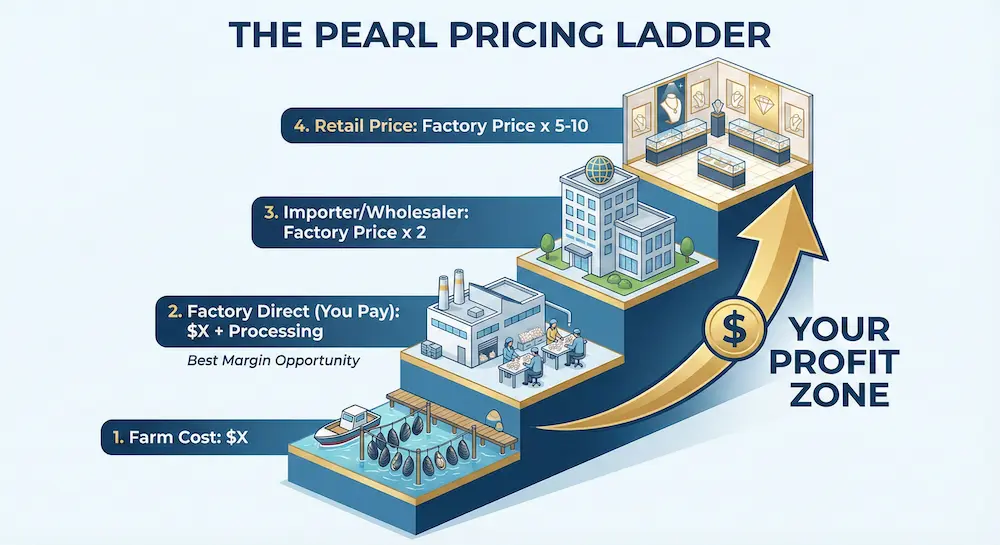
This pearl pricing guide will show you exactly how to calculate profit margins that actually make sense. No fluff, no guesswork. Just a simple formula that turns your pearl jewelry from pretty objects into profit machines.
Why Your Current Pearl Pricing Guide Is Probably Wrong
Walk into any jewelry trade show and you’ll hear designers complaining about the same thing. “I can’t raise my prices—customers won’t pay more!” Wrong. Your customers will absolutely pay more. They just won’t pay more for something that doesn’t feel premium.
The disconnect? Most jewelry makers don’t understand the difference between cost of goods sold jewelry and perceived value. A $10 Edison pearl can absolutely sell for $100 if you position it correctly. Why? Because it looks like a $300 South Sea pearl to the untrained eye.
That’s not dishonest—that’s marketing. And it’s exactly what luxury brands do every single day.
The Real Pearl Pricing Formula You Should Use
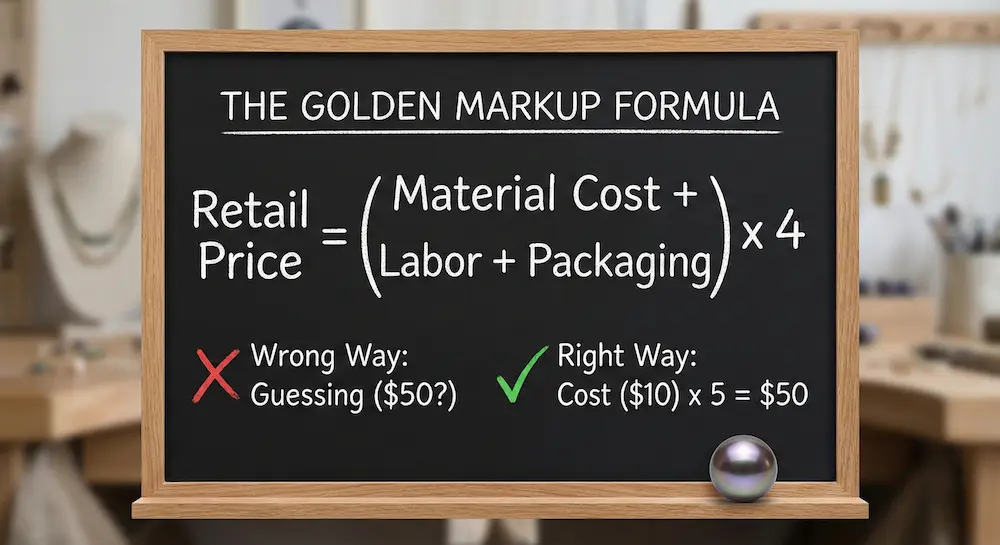
Forget complicated spreadsheets. Here’s the formula that actually works for your jewelry business profit margins:
(Materials + Labor + Overhead) × 2 = Wholesale Price
Wholesale Price × 2 = Retail Price
Let me break it down so it’s crystal clear.
Step 1: Calculate Your True Costs
Materials: This includes your pearls (obviously), findings, clasps, wire, and packaging. If you’re buying wholesale freshwater pearls at $15 per strand and using $5 in findings, your material cost is $20.
Labor: Here’s where most people screw up. They think, “Well, I enjoyed making it, so I shouldn’t charge much for my time.” Stop. You’re a professional. Track every minute you spend on a piece—from design to assembly to photography. If it takes you 2 hours and you want to make $30/hour, that’s $60 in labor.
Overhead: Rent, utilities, insurance, website hosting, that fancy camera you bought for product photos. Add it all up for the month, divide by the number of pieces you typically make, and you get your overhead per piece. Let’s say that’s $10.
Total costs: $20 (materials) + $60 (labor) + $10 (overhead) = $90
Step 2: Apply the Markup Formula for Handmade Jewelry
Using our formula:
- Wholesale price: $90 × 2 = $180
- Retail price: $180 × 2 = $360
See that? Your $90 piece should retail for $360. Not $120. Not $150. $360.
This is how great designers set their markups for hand-made jewelry. It’s not greedy—it’s smart business.
| Cost Component | Amount | Notes |
|---|---|---|
| Materials | $20 | Pearls + findings |
| Labor (2 hrs @ $30/hr) | $60 | Your professional rate |
| Overhead | $10 | Pro-rated monthly expenses |
| Total COGS | $90 | Your baseline cost |
| Wholesale Price | $180 | 2× markup from COGS |
| Retail Price | $360 | 2× markup from wholesale |
The “Perceived Value” Hack That Changes Everything
Not all pearls are created equal in your customer’s mind. A perfectly round, lustrous Edison pearl might cost you $30 from a Pearl Manufacturer. But to your customer? It looks identical to a $300 South Sea pearl. The surface quality, the size, the shine—all premium markers that justify a premium price.
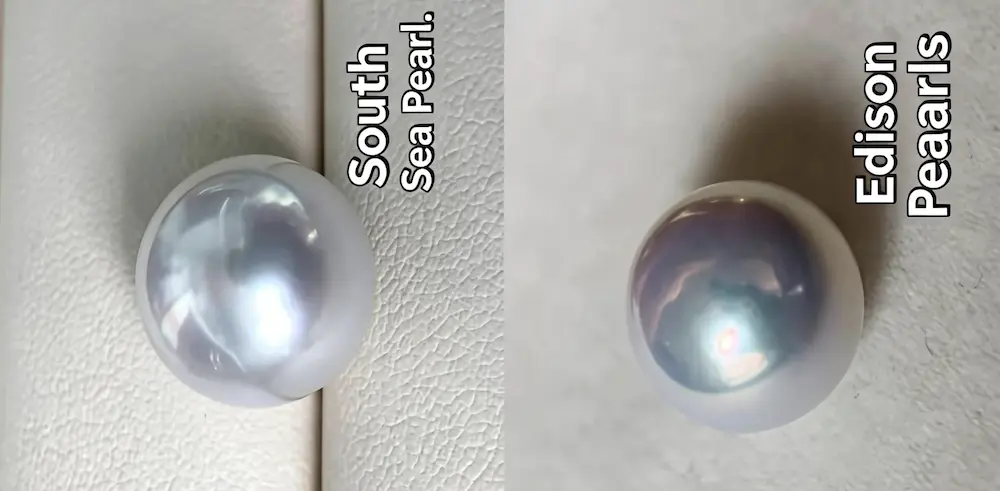
This is the secret sauce of the pearl pricing guide professionals use: wholesale vs retail pearl prices aren’t just about doubling numbers. They’re about understanding value perception.
Smart jewelry designers source their pearls strategically. They skip the middlemen who mark up wholesale pearls by 300%, and they go straight to manufacturers. The result? Lower cost of goods sold, higher profit margins, and prices that still feel fair to customers.
Real Numbers: The Xinye Pearl Case Study
Let’s get concrete. Say you’re creating a simple pearl bracelet.
Scenario A: Buying Through Middlemen
- Pearl strand from local supplier: $50
- Findings and materials: $8
- Labor (1.5 hours @ $30/hr): $45
- Overhead: $7
- Total COGS: $110
- Wholesale price: $220
- Retail price: $440
Scenario B: Direct from Xinye Pearl
- Pearl strand (same quality): $30 (40% savings)
- Findings and materials: $8
- Labor (1.5 hours @ $30/hr): $45
- Overhead: $7
- Total COGS: $90
- Wholesale price: $180
- Retail price: $360
Wait—shouldn’t you charge the same retail price either way? Absolutely not. Here’s the move: keep your retail price at $440, but reduce your COGS to $90. Your profit just jumped from $330 to $350 per piece—and you’ve got an extra $70 in margin to play with.
That $70 difference? It goes straight to your bottom line. Or it funds your marketing. Or it lets you offer occasional promotions without destroying your margins.
This is how you build a sustainable jewelry business. Not by charging less, but by being smarter about where you source.
Building a Pearl Pricing Guide That Scales
Here’s what separates hobby jewelers from professionals: systems. You can’t calculate every piece individually forever. You need pricing tiers that make sense.
Create Your Price Anchors
- Entry-level: Simple stud earrings, $80-150
- Mid-tier: Bracelets and simple pendants, $200-400
- Premium: Statement necklaces, complex designs, $500-1200
- Luxury: Custom work, rare pearls, $1500+
Within each tier, you maintain consistent jewelry business profit margins using the 2×2 formula. But the perception of each tier justifies the price jumps.
A customer who hesitates at $150 earrings might not even blink at a $600 necklace—because necklaces “should” cost more. Use that psychology to your advantage.
Track Your Numbers Like a CFO
You need three metrics on a dashboard:
- Average COGS per piece – Are your material costs creeping up?
- Average retail price – Are you maintaining your margins?
- Sell-through rate – Which pieces move fast, which sit on shelves?
If something isn’t selling at your target price, the problem usually isn’t the price. It’s the perceived value. Better photos, better descriptions, better storytelling—that’s what moves inventory at premium prices.
The Wholesale vs Retail Pearl Prices Strategy

Many jewelry designers eventually want wholesale accounts. Boutiques, galleries, online retailers. Here’s how that works with your pearl pricing guide.
Your wholesale price ($180 in our earlier example) becomes what retailers pay you. They then mark it up to their retail price—usually 2× to 2.5×, so around $360-450.
Critical rule: Never compete with your retailers by undercutting their prices. If a boutique sells your bracelet for $400, don’t turn around and sell the same piece on Instagram for $280. That’s how you lose accounts fast.
Instead, create exclusive pieces for wholesale and separate designs for your direct-to-consumer channels. Or offer different pearl types, different sizes, different styles. This protects everyone’s margins.
Common Pearl Pricing Mistakes That Kill Profit
Mistake 1: Emotional pricing. “I love this piece so much, I can’t charge that much!” Your love doesn’t pay rent. Use the formula.
Mistake 2: Race to the bottom. Someone on Etsy sells similar earrings for $40. So what? Are they still in business in two years? Compete on quality and brand, not price.
Mistake 3: Ignoring overhead. Your electricity bill, your workspace, your time answering emails—it all counts. If you’re not factoring it in, you’re losing money every single sale.
Mistake 4: Inconsistent margins. You can’t charge 200% markup on one piece and 75% on another just because you “feel” like it. Pick a system and stick to it.
Mistake 5: Not revisiting prices. Pearl prices fluctuate. Labor costs increase. Your skill level improves. Review your pearl pricing guide quarterly, not once in 2019 and then never again.
How to Implement Your New Pearl Pricing Guide Today
Stop overthinking. Start with these action steps:
Step 1: Calculate your true hourly rate. What do you need to earn to make this business sustainable? $25/hour? $50/hour? Be honest.
Step 2: Track your time on the next 10 pieces you make. Get real data on how long things actually take.
Step 3: Add up your monthly overhead. Everything from Etsy fees to that Ring light you bought.
Step 4: Apply the 2×2 formula to three pieces you currently sell. Compare the result to your current prices.
Step 5: Adjust your prices. Yes, it feels scary. Do it anyway.
According to the Gemological Institute of America, professional jewelers use systematic pricing approaches rather than guesswork. This isn’t just best practice—it’s the difference between staying in business and closing shop.
The Bottom Line on Pearl Pricing
Your pearl pricing guide isn’t just about numbers on a spreadsheet. It’s about valuing your work, your expertise, and your time. Every hour you spend undercharging is an hour you’re subsidizing your customers’ jewelry collections with your own financial future.
The formula works: (Materials + Labor + Overhead) × 2 = Wholesale then × 2 = Retail. Use it. Trust it. Adjust only when you have data that says you should.
And here’s the final truth most won’t tell you: premium pricing attracts premium customers. The people who balk at $360 for a pearl bracelet were never your ideal buyers anyway. The customers who appreciate quality, craftsmanship, and unique design? They expect to pay for it.
When you source smart—whether that’s working with wholesale pearl suppliers or going direct to manufacturers—you’re not just improving your margins. You’re building a business that can scale, hire help, take vacations, and actually put money in your retirement account.
That’s not greedy. That’s professional. And your pearl jewelry deserves nothing less.
Ready to optimize your pearl sourcing and double your margins? Xinye Pearl offers wholesale pricing direct from the manufacturer, cutting out middleman markups that eat into your profits. When you reduce your cost of goods sold by 40%, every piece you make becomes significantly more profitable—without changing a single price tag.
Visit our wholesale pricing catalog and see exactly how much you could save on your next pearl order. Your future CFO self will thank you.
FAQs About Pearl Pricing for Jewelry Businesses
How do I justify high prices to customers who shop on Amazon?
A: You don’t compete with Amazon. You compete on story, quality, and customer experience. Show your process, explain your sourcing, build a brand people want to buy from—not just buy products from.
Should I offer discounts and sales?
A: Rarely. And never more than 15-20% unless you’re clearing dead inventory. If your margins are right, you don’t need constant sales. Build value instead.
What if competitors charge less?
Let them. You’re not building a commodity business. You’re building a brand. Tiffany & Co. isn’t worried about what Claire’s charges for earrings.
How often should I update my pearl pricing guide?
A: Review quarterly. Adjust annually at minimum. Market conditions change, your skills improve, and your costs shift. Stay current.
Can I use different formulas for different pearl types?
You can, but consistency builds trust—with yourself and your customers. Pick one solid approach and apply it across your line.




 EN
EN  JA
JA  AR
AR  IT
IT  ES
ES  DE
DE  KO
KO