Pearl sourcing looks simple on paper. You find a supplier, negotiate a price per strand, and boom—you’re in business. But here’s what nobody tells you: the unit price is just the tip of the iceberg. The real costs? They’re lurking beneath the surface, quietly draining your margins while you’re focused on that seemingly great deal from overseas.
After working with hundreds of jewelry retailers at Xinye Pearl, I’ve seen this play out repeatedly. Companies get excited about a $12 per strand quote, only to realize their actual cost landed at $18 after factoring in everything else. That’s a 50% margin evaporation. And honestly? Most buyers don’t even know where the money went.
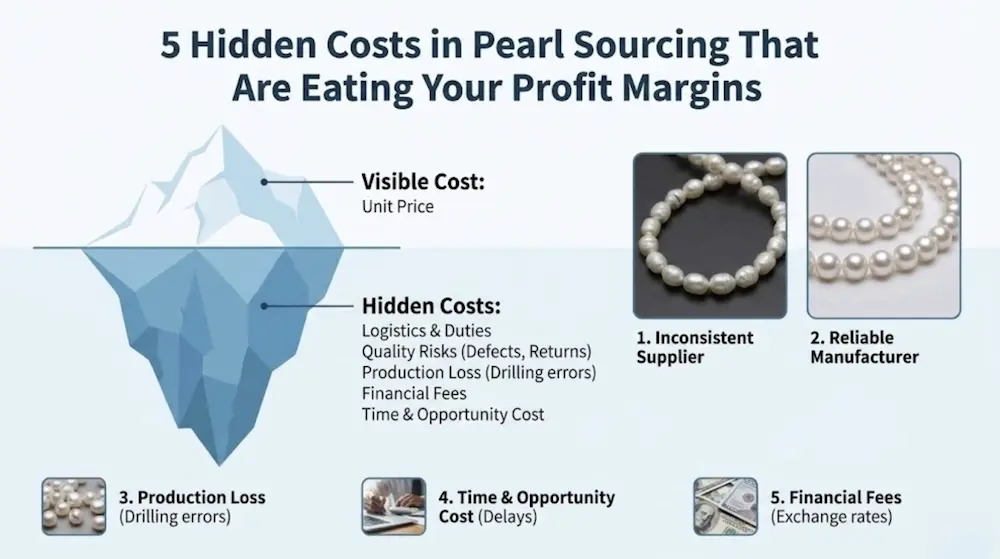
Let’s break down the five hidden costs that are silently killing your profits in pearl sourcing—and what you can do about them.
1. Shipping & Logistics: The Surprise Tax on Distance
Think shipping is just “the cost to get it here”? Think again.
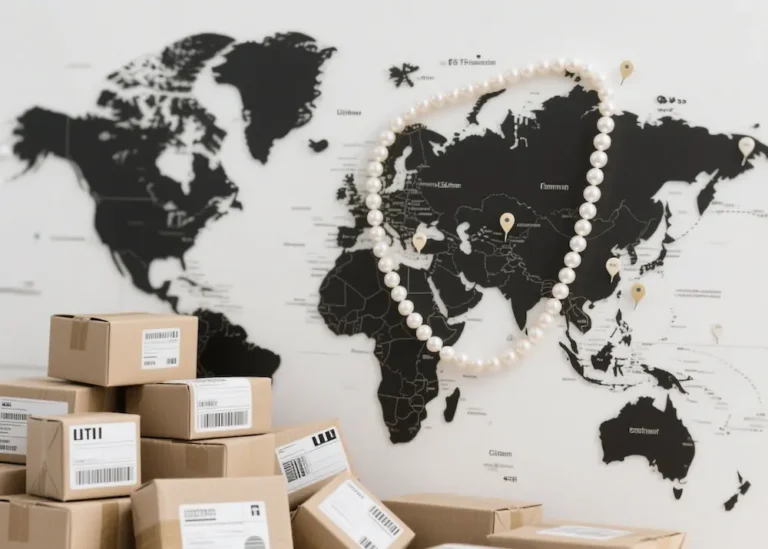
When you import pearls, especially wholesale pearls from China or other big manufacturing centers, the hidden costs of Pearl Sourcing add up quickly. Yes, we’re talking about shipping costs, but also fuel surcharges, high-season fees, remote area delivery fees, and customs clearance taxes that weren’t included in the initial price.
Here’s a real example: You order 1,000 strands at $10 each. Shipping adds $1,500 (freight) + $300 (fuel surcharge) + $450 (insurance for high-value goods) + $200 (customs broker fees). That’s $2,450, or $2.45 per strand. Your actual cost? $12.45, not $10.
But wait, there’s more. If your shipment hits port during peak season (think pre-holiday rush), expect air freight rates to spike 30-50%. Suddenly that “cheap” batch isn’t so cheap anymore.
How to Minimize Logistics Costs
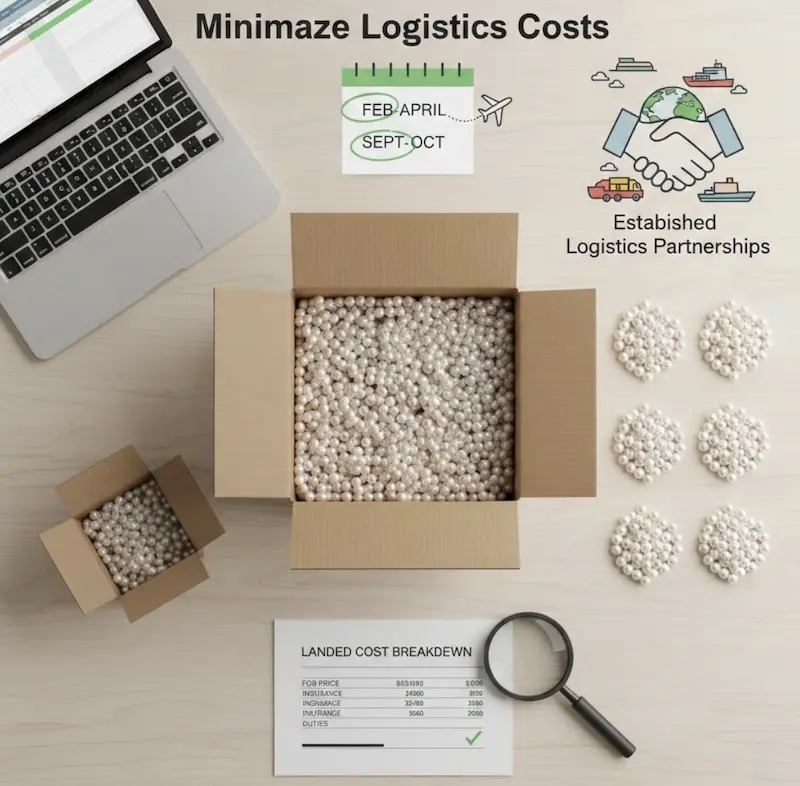
- Consolidate orders. Shipping 10,000 strands at once is exponentially cheaper per unit than five separate 2,000-strand orders.
- Plan ahead. Book shipments during off-peak months (February-April, September-October for most routes).
- Work with a Pearl Manufacturer that has established logistics partnerships. Established suppliers can negotiate better freight rates.
- Calculate landed cost upfront. Don’t just look at FOB pricing—demand a full breakdown including insurance and duties.
2. Quality Discrepancy: When 80% Good Means 25% Loss
This one’s brutal because you don’t see it coming until the shipment arrives, highlighting one of the most overlooked risks in pearl sourcing.
You ordered AAA-grade freshwater pearls based on sample photos. The supplier confirmed quality. Everything looked perfect. Then the boxes arrive, you open them, and reality hits: 15-20% have dull luster, 10% have surface flaws you can’t sell, and another 5% are off-size.
Do the math: If 30% of your $10,000 order is unusable, your effective cost per good pearl just jumped 43%. That “great deal” is now a nightmare.
The harsh truth? Sample quality and bulk quality are often two different universes. Samples come from the absolute best the supplier has. Bulk orders come from whatever’s in stock.
Real-World Impact
Let’s say you bought 500 strands at $15 each ($7,500 total). You discover:
- 75 strands (15%) have poor luster → Unusable
- 50 strands (10%) have surface defects → Downgrade to clearance
- 25 strands (5%) size inconsistency → Can’t match for sets
You effectively have 350 usable strands. Your actual cost per usable strand? $21.43, not $15. That’s a 42.9% increase.
Quality Protection Strategies
- Always order inspection samples from actual batch inventory, not cherry-picked showcase pieces
- Use third-party QC inspectors before shipment leaves the supplier (costs $200-500 but can save thousands)
- Define specific rejection criteria in contracts: luster grade, surface blemish percentage, size tolerance (±0.3mm is standard)
- Build in a 5-10% quality buffer in your pricing calculations
According to research from the Global Trade compliance experts, quality-related issues represent one of the largest hidden costs in international sourcing, often requiring expensive rework or replacement.
3. Drilling & Processing Errors: The Silent Profit Killer
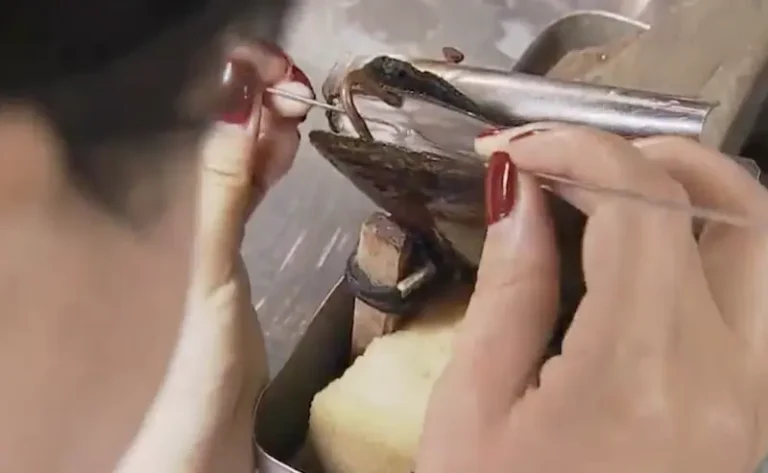
Here’s something most people don’t think about, yet it is a critical component of professional pearl sourcing: pearl drilling.
When you buy pre-drilled pearls, you assume the drilling is done correctly. But poor drilling technique causes 5-15% waste through:
- Off-center holes that make pearls unsellable for jewelry
- Drill-through damage where the bit chips the pearl surface
- Hole size inconsistency that won’t fit your wire gauge
- Sharp edges inside holes that fray and cut stringing material
A professional jewelry designer I know once received 2,000 baroque pearls with beautiful surfaces—but 18% had off-center holes that made them unusable for earrings. At $3.50 per pearl, that’s $1,260 in direct waste. She couldn’t return them because it wasn’t “technically” a defect by her supplier’s standards.
The Cost Calculation
- 1,000 pearls @ $4 each = $4,000
- 12% drilling defects = 120 unusable pearls ($480 loss)
- Effective cost per usable pearl = $4.55 (13.75% increase)
How to Avoid Drilling Disasters
- Specify drilling standards: hole diameter, centering tolerance, internal smoothness
- Request drill-sample photos from multiple angles before bulk production
- Consider buying undrilled and working with a trusted local driller (often more consistent quality)
- Test-string a small batch before accepting the full shipment
4. Exchange Rate & Transaction Fees: Death by a Thousand Cuts
Currency conversion and international payment fees are the quiet profit vampires of pearl sourcing that nobody talks about.
When you pay a Chinese supplier $10,000 USD, here’s what actually happens:
- Your bank converts USD to CNY (1-2% spread markup)
- International wire transfer fee ($30-50)
- Intermediary bank fees ($10-25)
- Currency fluctuation risk between order and payment
Real example: You negotiate a $15,000 order when the exchange rate is 7.0 CNY per USD. By payment time two weeks later, it’s shifted to 7.2. Your supplier charges in CNY, so you’re now paying an extra $428. Plus wire fees ($45) and bank conversion markup ($225).
Total unexpected cost: $698, or 4.65% of your order.
Do this 10 times a year? That’s $6,980 evaporating purely from financial mechanics.
Transaction Fee Minimization
- Use Wise (TransferWise) or similar services instead of banks (saves 2-4% per transaction)
- Negotiate USD pricing with suppliers to shift exchange risk to them
- Use forward contracts to lock in exchange rates for large orders
- Pay with USD stablecoins if the supplier accepts crypto (eliminates conversion fees entirely)
- Time payments strategically: Monitor exchange rate trends and pay when favorable
The logistics research from OpenBOM notes that currency fluctuations can introduce significant financial uncertainty into international sourcing operations.
5. Communication & Lead Time: Opportunity Cost Nobody Calculates
This is the most underestimated cost in pearl sourcing because it’s not a direct expense—it’s lost revenue.
Your supplier takes 48 hours to respond to emails. They’re 12 hours ahead, so real-time communication is impossible. A simple specification question takes four days to resolve. Your production timeline extends from 4 weeks to 7 weeks.
Now your seasonal products miss the Valentine’s Day rush. Or Mother’s Day. Or Christmas. You ordered inventory for peak season sales, but it arrives three weeks late. The market window closes.
The calculation everyone misses:
- Expected sales during peak 3 weeks: $45,000
- Actual sales after peak: $18,000
- Lost revenue: $27,000
- Order cost: $12,000
- Profit margin: 40% ($4,800)
Your “cheap” supplier just cost you $27,000 in lost sales and $4,800 in profit. How much did you save on unit price again?
Time-Cost Factors
| Issue | Average Delay | Revenue Impact |
|---|---|---|
| Slow response times | 3-7 days per question | Missed seasonal windows |
| Production delays | 2-4 weeks | Inventory carrying costs |
| Shipping delays | 1-3 weeks | Lost sales opportunities |
| Quality issues requiring reshipment | 4-8 weeks | Customer cancellations |
Communication Efficiency Tactics
- Establish SLA requirements: Response time under 24 hours, production updates every 3 days
- Use messaging apps (WeChat, WhatsApp) for faster communication than email
- Hire a sourcing agent in the supplier’s timezone if you’re doing high volume
- Build buffer time into your ordering schedule (order 8 weeks before you need it, not 4)
- Work with suppliers who have dedicated export teams with English-speaking staff
- Video call monthly to build relationships and solve problems faster
The Total Cost Reality Check
Let’s add it all up with a real-world scenario:
Initial Quote:
- 5,000 pearl strands at $12 each
- Total quoted: $60,000
- Expected margin: 35% ($21,000 profit)
Hidden Costs:
- Logistics & insurance: +$1.85/strand = $9,250
- Quality issues (18% unusable): +$2.60/strand = $13,000
- Drilling defects (8%): +$1.15/strand = $5,750
- Exchange rate & fees (3.5%): = $2,100
- Delayed shipment lost sales: = $15,000 in opportunity cost
Actual Total Cost:
- Direct costs: $90,100 (not $60,000)
- Opportunity cost: $15,000
- Combined impact: $105,100
Margin Reality:
- Expected profit: $21,000
- Actual profit: -$9,100 (loss!)
This is how pearl sourcing eats margins alive.
How Xinye Pearl Addresses These Hidden Costs
We at Xinye Pearl have set up our business in a way that gets rid of these things that hurt profits:
- All-inclusive landed cost quotes: Our pricing includes logistics, insurance, and realistic handling fees upfront
- In-process quality verification: Third-party QC inspection before shipment with photo/video documentation
- Drilling standards: Machine-precision drilling with under 2% defect rate and full replacement guarantee
- USD pricing with rate lock: 30-day price protection against currency fluctuation
- 24-hour response SLA: Dedicated account managers in your timezone for faster problem resolution
We’re not the cheapest option. But we’re the option that doesn’t surprise you with hidden costs that turn a “good deal” into a money pit.
The Bottom Line
Pearl sourcing isn’t about finding the lowest unit price. It’s about understanding the total landed cost—and the hidden factors that inflate it by 30-50% if you’re not careful.
Before you sign that next buy order just because of the price per strand, think about these things:
- What’s the total landed cost including all logistics and fees?
- What’s the quality guarantee, and what happens with defective pearls?
- What are the drilling specifications and defect replacement policy?
- How do you deal with changes in currency value, and what are the specific rates for payments?
- What’s the communication SLA and backup plan if production delays occur?
The suppliers who can answer these questions clearly? Those are the ones protecting your margins. The ones who dodge them or say “we’ll handle it”? They’re the ones eating your profits.
Want to see how much hidden costs are actually impacting your pearl sourcing? Calculate your last three orders’ true landed costs. The number might shock you.
FAQs About Pearl Sourcing Hidden Costs
How do I calculate total landed cost for pearl sourcing?
Total landed cost = (Unit Price × Quantity) + Freight + Insurance + Customs Duties + Broker Fees + Currency Conversion Fees + (Defect Rate % × Total Order Value). Don’t forget to factor in quality losses and potential delays.
How can I protect myself from exchange rate losses?
Request USD-denominated invoices, use currency forward contracts for large orders, utilize low-fee payment services like Wise, or negotiate rate lock periods (15-30 days) with suppliers. A 2% change in the value of the currency on a $50,000 order will cost you $1,000.
What questions should I ask suppliers about drilling quality?
Ask about: drilling equipment used (manual vs. machine), hole diameter and tolerance, centering precision, internal smoothness standards, and defect replacement policy. Request drilling sample photos before production and specify maximum acceptable defect percentage (typically 2-5%).