This guide is for the jewelry brand owner, the retail buyer, and the Esty/Amazon seller who needs to make real procurement decisions — not someone buying a strand for their mom’s birthday.
We’ve run a pearl farm in Ma’anshan city Anhui province and a processing factory in Changzhou for over 30 years. We’ve seen every mistake a new buyer can make. This is the guide we wish someone had handed to our first overseas clients in 1995. If you’re sourcing freshwater pearls for the first time — or if you’ve been burned before — read every section.
Why freshwater pearls dominate the wholesale market
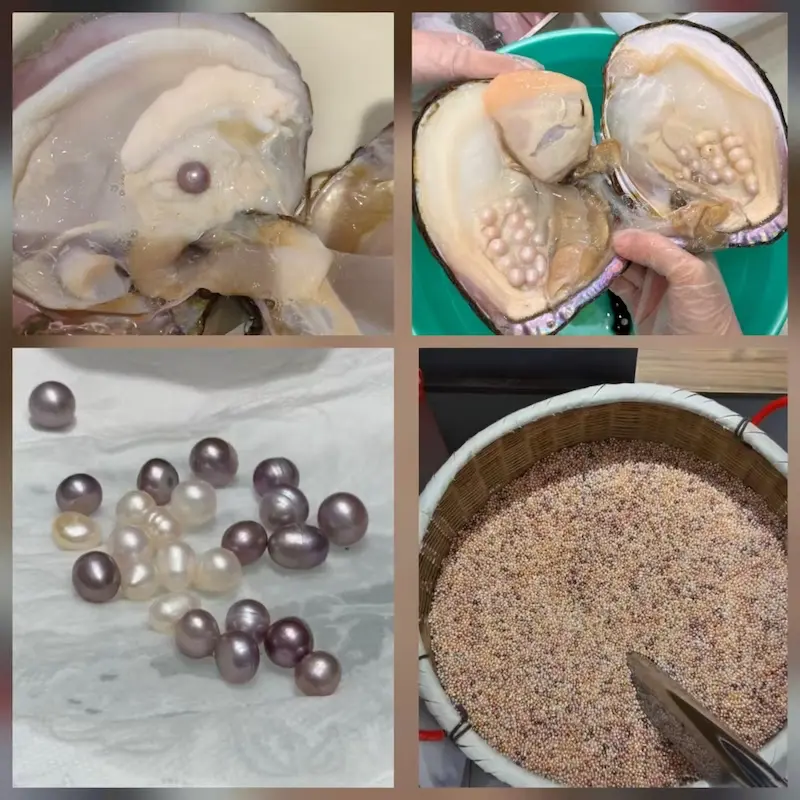
The numbers are simple. One saltwater oyster produces one pearl per cycle. One freshwater mussel (Hyriopsis cumingii, the triangle-sail mussel farmed across Anhui and Zhejiang provinces) produces 1-2 and 20 to 40 pearls per cycle. That’s the entire economic argument.
Because the yield per mussel is so high, freshwater pearls hit a price-per-gram that no saltwater variety can match at scale. For a brand building collections in the $50–$500 retail range, this matters. For a private-label buyer doing 5,000-piece runs, this is everything.
That volume advantage also means tighter grading is possible. A pearl manufacturer with enough throughput can actually sort at scale — pulling clean top-grade rounds from a production lot of 50,000 pieces without the sort ruining the economics. Saltwater operations can’t do that. They’re too small. Their margins can’t absorb the labor.
The grading system: what “AAA” actually means at the factory level
Here is where most new buyers get confused — or get scammed.
Retail websites love “7A” and “8A” labels. Those grades don’t exist in any international standard. The wholesale industry runs on A through AAAAA — five tiers. That’s it. Anything marketed as “7A” or “8A” is a retail invention with no grading infrastructure behind it.
The three parameters that define freshwater pearl grading for wholesale buyers:
| Grade | Luster | Surface cleanliness | Shape | Best commercial use |
|---|---|---|---|---|
| AAAAA | Mirror — razor-sharp reflection, visible depth and orient | 98%+ clean, virtually flawless | Perfect round, deviation < 1% | Luxury fine jewelry, top-tier retail |
| AAAA | Strong mirror — sharp highlight, minor diffusion at edges | 95%+ clean surface | Perfect to near-round, deviation < 2% | Fine jewelry, premium bridal |
| AAA | Strong — clear highlight, visible glow | Light blemishes, not visible at arm’s length | Near-round, baroque acceptable in mixed lots | Designer collections, mid-tier retail |
| AA | Soft — visible glow but no sharp reflection | Visible marks, concentrated on one side | Button, oval, off-round | Fashion jewelry, mass market |
| A | Chalky — low luster, dull surface | Heavy marks, pitting | Baroque, irregular | Costume/craft use |
When you’re buying, ask for the grade and the lot photos. Any supplier who quotes “AAA” but won’t send a photo under D65 standard lighting is not grading to a standard — they’re grading to whatever price point you look willing to pay.
At our Changzhou factory, every lot goes through a final sort under D65 standard lighting — the industry benchmark for neutral daylight grading — before any shipment leaves. If the surface cleanliness doesn’t match the spec sheet, the lot gets pulled.
Luster and nacre: the two numbers that determine your retail price ceiling
Luster is not a vibe. It’s an optical property.
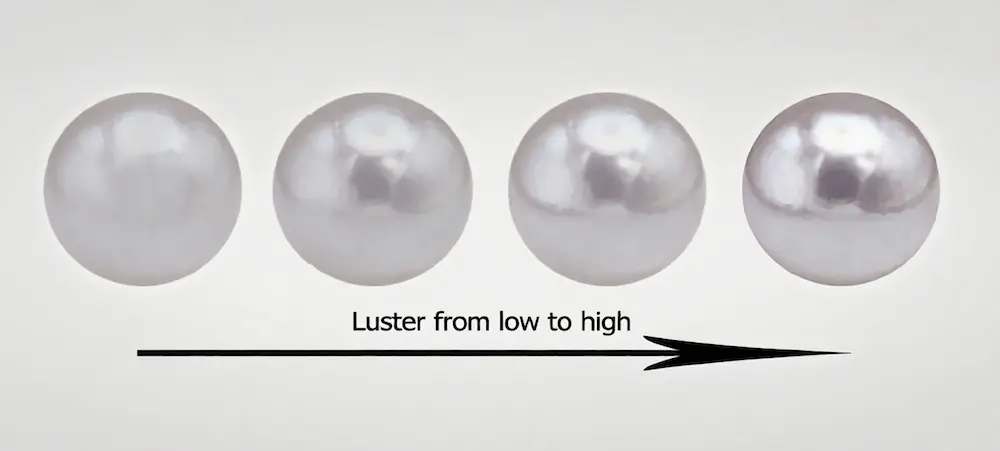
Pearl luster comes from the way light moves through translucent nacre layers. Thin nacre = shallow light penetration = flat, chalky surface. Thick nacre = deep light travel = the “mirror” effect buyers and consumers instinctively recognize as quality.
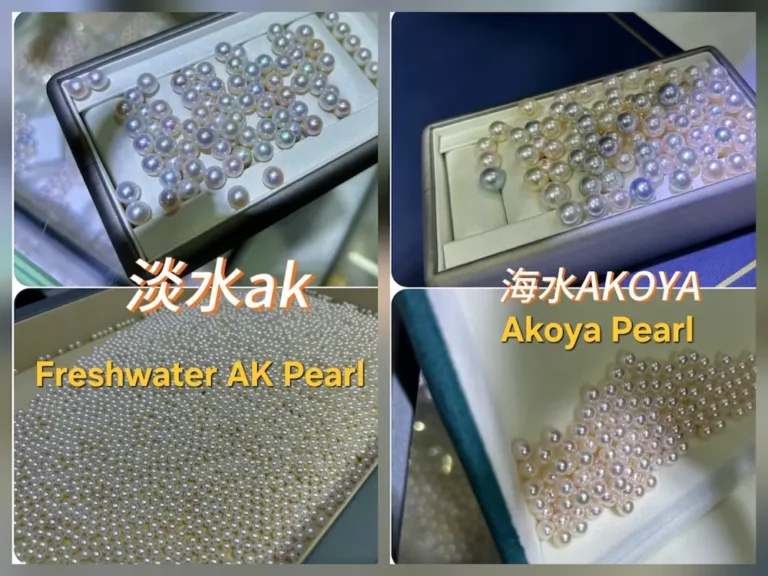
Freshwater pearls come in two structural types, and both outperform akoya on nacre depth. Non-nucleated freshwater pearls — the industry standard for sizes under 10mm — are grown with a tissue graft, no bead core. The entire interior is nacre, 2–5mm thick depending on grow time. Bead-nucleated freshwater pearls (Edison pearls & Freshwater AK pearls) use a round nucleus, but the nacre layer deposited over 3–5 years still reaches 1–2mm — several times thicker than a typical akoya coating of 0.3mm. An akoya pearl is a bead coated in nacre. That coating is thin by design, because saltwater oysters can only tolerate one pearl per cycle and farmers harvest early to manage risk.
This matters for durability. A saltwater pearl with thin coating wears down. The luster fades in years. A properly grown freshwater pearl with full nacre — grown for 3 to 5 years in our Ma’anshan farm — holds luster for decades under normal wear.
The commercial implication: if your brand makes claims about longevity or heirloom quality, freshwater pearls support those claims structurally. Akoya at the same price point cannot.
For buyers curious about nacre depth measurement methodology, CIBJO’s pearl grading standards provide the reference framework used by serious trade suppliers.
Size tiers and what moves at wholesale in 2026
Not all sizes sell the same way. Here’s what we’re seeing in our current order flow:
| Size | Pearl count per 16″ strand | Wholesale price range (AAAAA round) | Where it moves |
|---|---|---|---|
| 5–6mm | ~70 pieces | $30–$60/strand | Stud earrings, children’s sets, entry bridal |
| 6–7mm | ~58 pieces | $35–$65/strand | Classic necklaces, bracelet-building, core catalog |
| 7–8mm | ~50 pieces | $65–$130/strand | Premium retail, designer sourcing |
| 9–10mm | ~38 pieces | $130–$260/strand | Statement pieces, luxury catalog |
| 11–12mm+ (Edison) | ~28 pieces | $280–$600+/strand | High-end retail, collector market |
Edison pearls — the large-format round freshwater pearls grown with a partial nucleus — deserve a separate note. Supply of clean, round, 12mm+ Edison pearls in AAAAA grade is genuinely constrained. If you’re building a luxury line and want to lock in supply, do it now. We’ve seen Edison pricing move 20–30% in 18-month windows when Zhejiang production runs are short.
The 6–7mm tier is the workhorse of wholesale pearls. If you’re building a first catalog, start there. The supply is consistent, the sort quality is easy to verify, and the retail margin works at nearly every price point.
How to place your first bulk order: a practical walkthrough
Most new buyers waste two to four weeks in the wrong conversation. Here’s how to skip that.
Step 1: Know your spec before you email anyone.
You need: size range (e.g., 7–8mm), shape (round, near-round, baroque), grade (AAA or AAAA), color (white, pink, lavender, mixed), and quantity (number of strands or kilograms). If you don’t know the quantity yet, say “sample order” — we sell mixed sample lots starting at 10 strands so buyers can verify quality before committing to volume.
Step 2: Request photos or videos under proper lighting.
Any legitimate pearl supplier sends photos under D65 or natural daylight. If the photos are on a dark velvet background with dramatic side lighting, that’s photography — not grading. Ask for flat lay shots in daylight.
Step 3: Understand your lead time.
Stock items — ship within 7 to 10 days from Changzhou. Custom jobs or size-matching for a specific necklace length need 2 to 5 weeks. If you’re on a hard seasonal deadline, say so upfront. We build around deadlines, but we need to know them early.
Step 4: Confirm packaging spec.
Are you receiving loose pearls by pieces or the kilogram? Pre-strung strands? Knotted strands ready for retail? Each configuration has different pricing and affects your landed cost. Know which format you need before the quote is issued.
Step 5: Place a sample order first.
We recommend it. I’ve seen buyers skip samples on the first $30,000 order because they trusted a price. Then the color was slightly pinker than expected, or the matching wasn’t tight enough for their necklace setting. A $200 sample order prevents a $30,000 mistake.
The shapes most buyers underestimate
Round pearls get all the attention. But for brands building fashion-forward or sculptural jewelry lines, baroque and keshi freshwater pearls are worth serious attention.
Baroque pearls — irregular, asymmetric shapes — have seen a 40% increase in designer demand since 2022. They’re not lower quality. They’re a different product. A clean AAAAA-luster baroque pearl with strong orient (the iridescent surface color play) commands real money in contemporary jewelry. Some of our European clients pay more per gram for premium baroque than for standard rounds.
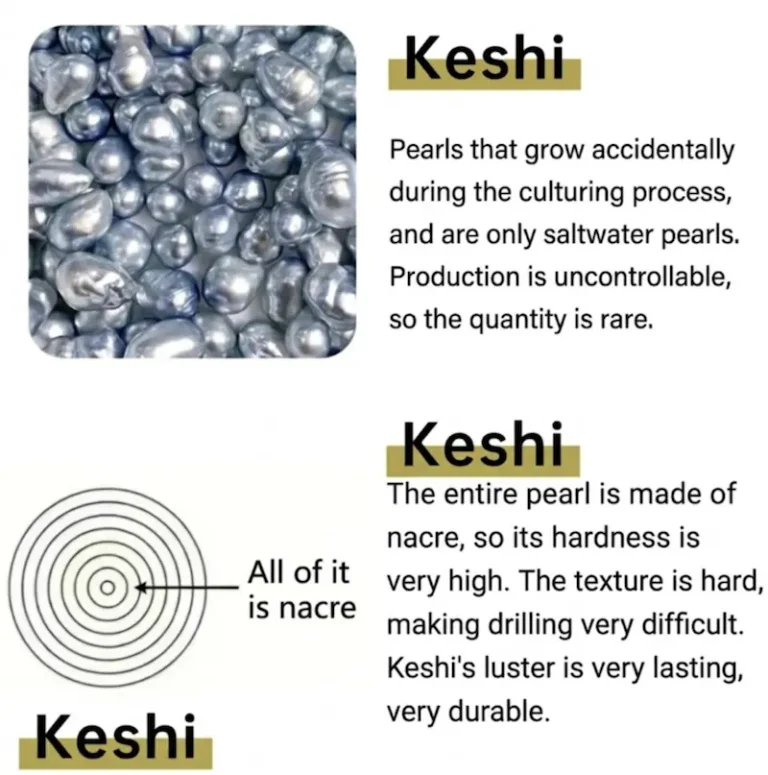
Keshi pearls (the small, flat, all-nacre byproduct pieces from nucleation) are 100% nacre, extremely high luster, and sell fast in clusters, earring components, and pave-style settings. Supply is unpredictable — keshi is a byproduct, not a targeted harvest — so if you see a good lot, buy it.
FAQs
What is the difference between freshwater pearls and akoya pearls for wholesale sourcing?
Freshwater mussels yield 1-2 picecs or 20–40 pearls each; akoya oysters yield one. Freshwater pearls come in two types: tissue-nucleated (no bead core, 100% nacre throughout) and bead-nucleated Edison pearls (larger format, partial nucleus). Akoya pearls are always bead-nucleated, with a thin nacre coating over the core. For consistent supply under 10mm at competitive landed cost, freshwater wins.
How do I verify that a “AAAAA” grade claim from a supplier is real?
Ask for flat-lay photos under D65 lighting and confirm their surface tolerance at AAAAA — the answer should be 98% or cleaner. If a supplier can’t answer that specifically, the grade is a marketing label.
What’s a realistic minimum order quantity for freshwater pearls wholesale?
Sample runs start at 5–20 strands. Any supplier quoting “wholesale price” at 2 strands is selling retail.
Are dyed freshwater pearls worth buying?
Yes — thick nacre holds dye well and the color is stable. Require written confirmation of natural vs. treated color on your invoice before the order ships.
How do I source freshwater pearls consistently for a growing catalog?
Work directly with a pearl manufacturer, not a trading company. Trading companies mark up and don’t control production — which means they can’t fix problems when they happen.
·Sourcing freshwater pearls doesn’t have to be a gamble. Know your spec, verify the grade, start with a sample, and work with a supplier who owns the production — not one who buys from someone who does.